West Bengal BJP Leader Questions Amartya Sen's Contributions, Ignites Political Firestorm
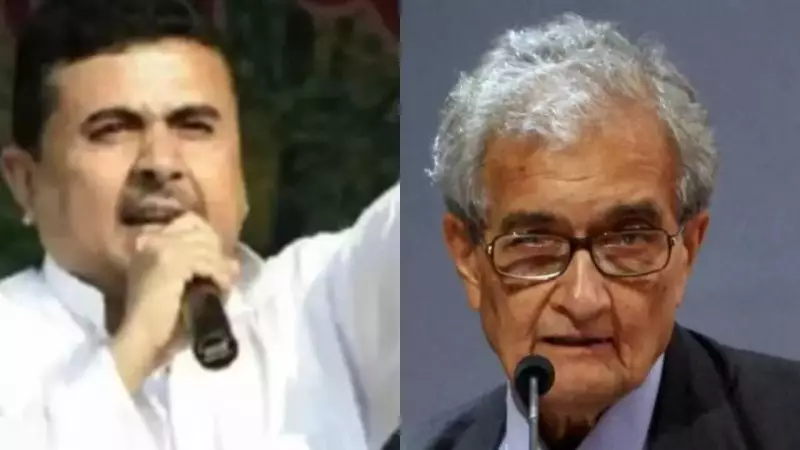
In a controversial statement that has ignited a major political row in West Bengal, BJP leader of opposition Suvendu Adhikari on Monday publicly questioned the "contribution" of Nobel laureate economist Amartya Sen to the state. The remarks have drawn sharp criticism from the ruling Trinamool Congress (TMC) and the Communist Party of India (Marxist) (CPM), who have rallied to defend the globally respected intellectual.
Adhikari's Direct Challenge to Sen's Legacy
Adhikari's comments came just days after Sen, who recently received a Special Investigation Report (SIR) hearing notice, expressed concerns that the verification process was being "conducted in a hurry" ahead of the upcoming assembly elections scheduled in a few months. The BJP leader did not mince words in his assessment of the economist's impact on Bengal.
"It is usual for him to make such comments. He does not have any contribution to Bengal," Adhikari stated emphatically. "Has he ever created a job opportunity for an educated youth in Bengal? There is no example that shows that he stood by a poor man."

In his earlier remarks about the SIR process, Sen had acknowledged that "a thorough review of electoral rolls done carefully with adequate time can be a good democratic procedure" but voiced serious apprehensions about whether this was actually happening in Bengal this time around.
TMC's Scathing Response to Adhikari's Remarks
The ruling Trinamool Congress wasted no time in condemning Adhikari's comments, labeling them as "unwarranted" and accusing the BJP leader of attempting to undermine a globally respected intellectual. The party issued a strongly worded statement on social media platform X that directly attacked Adhikari's credibility and motives.
"A mind incapable of understanding economics naturally attacks economists. A career built on opportunism naturally despises integrity. And a man allergic to ideas predictably lashes out at intellect," the TMC statement declared.
The TMC also pointedly noted that Adhikari had switched from their party to the BJP approximately five years ago, suggesting his current position was politically motivated rather than based on principle.
CPM's Historical Perspective on the Controversy
CPM central committee member Sujan Chakraborty provided additional context to the controversy by recalling that Adhikari had previously been critical of Sen when the Nobel Laureate had advocated for industrialization in Bengal. At that time, Adhikari was a TMC leader, and Chakraborty suggested his position was designed to please his political masters of that era.
"Adhikari was a TMC leader then and tried to please his then-political masters," Chakraborty pointed out. "Today, he is saying what his political masters in BJP would like to hear. He does not have any capacity to assess Sen."
The CPM leader's comments highlight what opposition parties see as a pattern of political opportunism in Adhikari's shifting positions on various issues, including his assessment of prominent figures like Amartya Sen.
Broader Political Implications in West Bengal
This controversy emerges at a particularly sensitive political moment in West Bengal, with assembly elections looming on the horizon. The exchange represents more than just a war of words between political rivals—it reflects deeper ideological battles about development, intellectual contribution, and political credibility in the state.
The debate over Amartya Sen's legacy has become a proxy for larger political arguments about:
- The role of intellectuals in public life
- Definitions of meaningful contribution to society
- Political authenticity versus opportunism
- The upcoming electoral process and its integrity
As West Bengal prepares for another intense electoral battle, this controversy over one of India's most celebrated intellectuals has added another layer of complexity to an already heated political landscape. The differing perspectives on Sen's contributions reveal fundamental disagreements about what constitutes meaningful service to the state and its people.