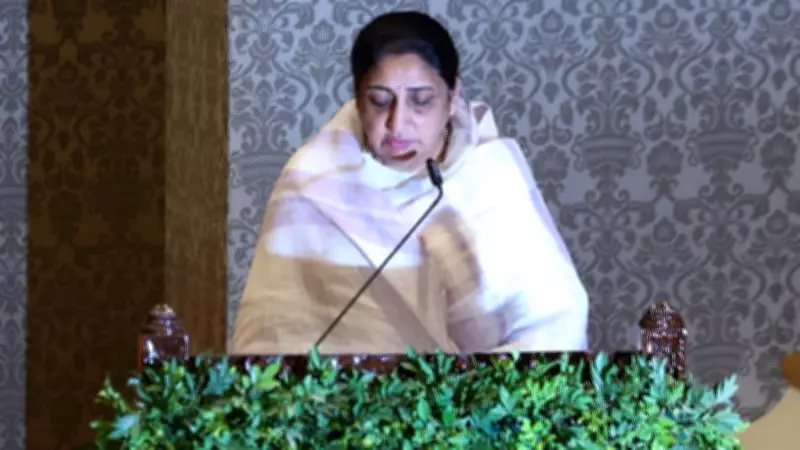
BJP Faces Coalition Uncertainty as NCP Leadership Question Looms After Sunetra Pawar's Entry
The Bharatiya Janata Party (BJP) is confronting renewed challenges within Maharashtra's ruling coalition as the Nationalist Congress Party (NCP) moves to consolidate its organizational control following Sunetra Pawar's induction as Deputy Chief Minister. However, fundamental questions about who will ultimately wield authority within the Maratha-dominated party remain unresolved, creating additional complications for the BJP's coalition management strategy.
Leadership Vacuum and Coalition Complications
Sunetra Pawar was sworn in as Deputy Chief Minister of Maharashtra after the position became vacant following her husband Ajit Pawar's death. While her entry into government represents the NCP's effort to assert control over its organization, BJP leaders privately acknowledge that managing coalition politics has become more difficult in the absence of a leader who commands acceptance across both the Sharad Pawar and Ajit Pawar factions at the grassroots level.
The situation is particularly complex given the NCP's strong Maratha support base, which Ajit Pawar had effectively mobilized during his political career. His death has created a significant vacuum within this crucial constituency, with Rajendra Kondhare, president of the Akhil Bharatiya Maratha Mahasangh, noting that "a sizeable Maratha community, especially those connected with institutional and cooperative networks, has always looked upon Sharad Pawar as their leader for support and guidance."

Public Displeasure and Internal Challenges
NCP-SP president Sharad Pawar publicly expressed his displeasure on Wednesday regarding BJP leader Devendra Fadnavis questioning the proposed merger between the two NCP factions. His remarks were widely interpreted as a clear signal to party workers about maintaining ideological continuity despite organizational splits.
"I am happy that Sunetra Pawar has taken the oath of office as Deputy Chief Minister in the government," Pawar stated officially. "On the merger issue, the talks were going on between Ajit Pawar and Jayant Patil. What right does Devendra Fadnavis have to question the merger when he was not involved?" He emphasized that his current focus remains on family ties rather than political negotiations.
BJP's Strategic Position and Uncertain Roadmap
BJP strategists acknowledge internal challenges but maintain their commitment to supporting the Ajit Pawar faction of the NCP. A party functionary explained, "The NCP versus NCP-SP dynamic will play out on multiple fronts. But our concern is to strongly back the NCP faction that has pledged support to the NDA. We remain committed to the family of Ajit Pawar and his political legacy."
Senior leaders admit there is no clear roadmap forward. One minister noted, "There are no final solutions as we cannot predict how political dynamics will evolve. From our understanding, Sunetra Pawar, along with the NCP organization, will work to maintain cohesion and consolidation while in power." With state elections still several years away, sitting Members of Parliament are unlikely to explore alternatives including the Sharad Pawar-led NCP-SP faction.
Maratha Community Dynamics and Political Implications
The Maratha community's political alignment remains unsettled following Ajit Pawar's death. Kondhare observed that "some unrest in this segment is inevitable" and that "to attain the leadership stature like Ajit Pawar requires 20 to 25 years of political work." The community now faces uncertainty about who will fill the leadership vacuum created by his passing.
An NCP minister who previously served under Sharad Pawar highlighted that ideological continuity has kept the party's support base intact despite organizational splits. "Those who do not subscribe to right-wing politics always found a credible alternative in NCP-SP. Despite the party division, we shared common ideology and electoral base," he explained, adding that cadres traditionally did not distinguish between the senior and junior Pawar in terms of political allegiance.

BJP's Historical Strategy and Current Dilemma
The BJP's core electoral strength in Maharashtra has traditionally been among Other Backward Classes (OBCs), with its 2024 Assembly victory partly driven by OBC consolidation amid polarization over Maratha reservation demands. By incorporating leaders like Shiv Sena's Eknath Shinde and NCP's Ajit Pawar into the Mahayuti alliance, the BJP successfully projected strong Maratha representation within the ruling coalition.
However, the party has struggled to develop an in-house Maratha leader capable of matching the influence of the Pawar family. While its strategy of inducting prominent Maratha leaders from other parties—including Ashok Chavan, Radhakrishna Vikhe Patil, and Narayan Rane—yielded electoral benefits, it has not created sustainable leadership within BJP ranks.
A political observer noted that "in a three-party coalition government with inherent friction, BJP always played Ajit Pawar versus Eknath Shinde to maintain control over government and state politics." With Ajit Pawar's presence, the ruling combine could effectively manage Maratha community concerns. Now, with Sunetra Pawar's entry and unresolved leadership questions, the BJP faces renewed challenges in maintaining coalition stability while addressing Maratha political aspirations.