Bihar's Bonded Labour Crisis: Modern Slavery Persists Despite 1976 Abolition Act
The recent rescue of bonded labourers from brick kilns in Gaya, coupled with the harrowing case of a 15-year-old boy from Kishanganj whose arm was severed by a fodder machine while working on a Haryana farm, has starkly highlighted a persistent and uncomfortable reality. These incidents, though briefly capturing public attention, represent merely the visible tip of a much deeper and more entrenched crisis—the stubborn persistence of modern slavery operating in plain sight across India.
A Legacy of Unbroken Chains
Nearly half a century after the enactment of the Bonded Labour System (Abolition) Act of 1976, the invisible shackles of debt bondage continue to enslave thousands of workers originating from Bihar. The state occupies a particularly troubling dual role in this grim narrative, functioning simultaneously as a major source region and, in certain districts, a destination for this exploitative labour.
A senior official from Bihar's Labour Resources and Migrant Workers' Welfare Department, speaking anonymously, revealed systemic implementation failures. "Almost everyone is aware of the Act on paper, but significant discrepancies exist in ground-level execution," the official stated. "Irregularities in interstate correspondence and inadequate interdepartmental communication severely hinder progress. The bonded labour graph appears fluctuating because data collection is inconsistent, with cases not being systematically filed and compiled."

The Geography of Exploitation
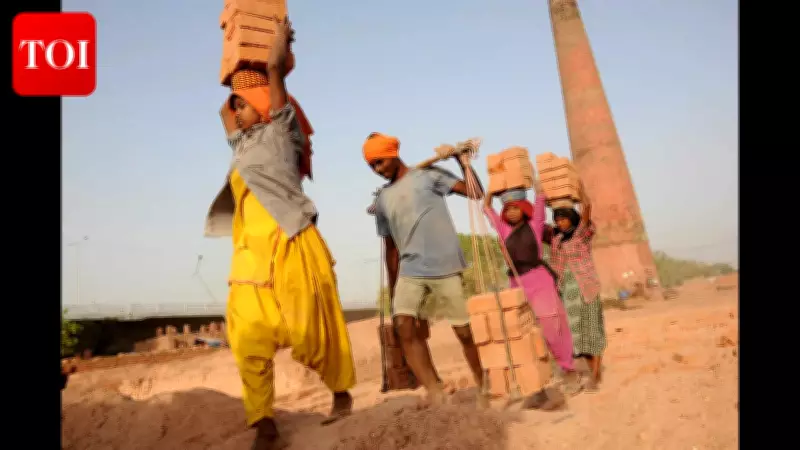
Data from the department paints a picture of stark geographical disparity. Alarmingly, less than 10% of bonded labourers linked to Bihar are identified and rescued within the state's own borders. In contrast, nearly 90% are found and freed in distant states including Delhi, Rajasthan, Uttar Pradesh, Punjab, Tamil Nadu, and West Bengal. In these locations, migrant workers from Bihar are subjected to grueling conditions in carpet industries, bangle factories, construction sites, and textile units.
Within Bihar itself, districts such as Gaya, Nawada, Jehanabad, Darbhanga, and Nalanda have been identified as primary source regions feeding this relentless pipeline of exploited labour. Notably, Gaya holds the dubious distinction of appearing both as a significant source and a destination district for bonded workers.
However, sources familiar with these cases indicate that the map of exploitation is even broader. "East Champaran, West Champaran, Khagaria, and Jamui are also major hotspots, functioning as destination districts where labourers are forced into bidi manufacturing, brick kilns, and agricultural work," disclosed a source with deep knowledge of the issue.
The Most Vulnerable Victims: Children
The human cost of this crisis is perhaps most heart-wrenching when examining the plight of the children ensnared within it. Children, particularly boys aged between 5 and 14, are the most vulnerable demographic, often entering bondage alongside their families to pay off ancestral or family debts. The majority of rescued victims are male children from minority communities.
"The recorded number of children is disproportionately high because entire families migrate together; if there are two adults, the children often outnumber them," explained a source. This intergenerational cycle of debt ensures that bondage is passed down, trapping successive generations.
The Entrenched Nexus and Legal Loopholes
Sustaining this oppressive system is a deeply entrenched network involving kiln owners, middlemen, and labour agents operating seamlessly across state lines. According to the senior official, this network expertly exploits legal loopholes and jurisdictional limitations.
"Offenders often manipulate the system to bypass laws, making tracking exceptionally difficult. A major legal loophole is that offenders cannot be penalized from other states as it falls outside local jurisdiction, which shifts the enforcement focus almost entirely to victim rehabilitation rather than perpetrator prosecution," he elaborated.

A source from a private organization with two decades of experience handling these cases described the mechanics of entrapment: "Bonded labour occurs when a person is compelled to use their physical labour to repay an ancestral debt or because forefathers took advances they could not clear, forcing the next generation to assume the burden. When families face calamities, middlemen provide money from owners. In return, they are contractually obligated to work at specific brick kilns once the season commences, with no freedom to seek employment elsewhere."
From Advance to Endless Servitude
What begins as a desperate advance payment during a crisis rapidly mutates into a system indistinguishable from slavery in all but name. "It is an 'endless cycle' where illiterate workers cannot track their own labour, middlemen deliberately undercount production, and wages never suffice to cover the initial advance. Even the Rs 500 weekly 'bhatta' for rations is not a true wage; it is simply added to their mounting debt," the source added.
Life within these labour camps is characterized by conditions that starkly violate human dignity. There are no hygienic facilities or proper housing. Workers subsist under plastic roofs and are forced to labour from dawn until dusk without fixed hours. Children are kept confined and systematically deprived of education and schooling.
The captivity, while not always physical, is no less real. "They might not be literally 'bonded' with chains, but are constantly supervised by middlemen and monitored by CCTV cameras. One family member might occasionally be allowed to leave, but the rest are held captive. Even their crucial documents, like Aadhaar cards, are confiscated and held by the owner, directly contravening fundamental rights to freedom," she emphasized.
Systemic Failures in Enforcement and Rehabilitation
Despite legal mandates requiring district magistrates and sub-divisional magistrates to conduct regular inquiries, proactive intervention remains exceptionally rare. "Inspections are not happening with any regularity. Even when surveys are conducted, victims are rarely correctly identified as bonded labourers. There must be sustained advocacy for the release certificate (RC), which formally identifies victims as bonded labourers. Without this certificate, owners continue to threaten families for repayment," the source explained.
The economic devastation triggered by the COVID-19 pandemic further tightened the grip of this exploitative system. With severely limited industrial opportunities within Bihar and the restricted reach of government welfare schemes, countless rural families continue to face a brutal choice between starvation and entering bondage.
Stories Fading into Bureaucratic Silence
The narrative inevitably returns to the recently rescued workers in Gaya and the injured adolescent from Kishanganj—stories that momentarily seized national headlines before fading into bureaucratic oblivion. Despite the significant attention their cases initially garnered, both sets of victims remain trapped in a distressing administrative limbo. To this day, these individuals have yet to receive their bonded labour release certificates. Without these essential documents, the critical process of rehabilitation and compensation cannot legally commence, leaving them in a state of unresolved vulnerability.
The persistence of bonded labour in Bihar, nearly 50 years after its official abolition, underscores a profound failure in governance, inter-state coordination, and social justice. It reveals a system where laws exist on paper but are rendered ineffective by poor implementation, exploitative networks, and the desperate economic circumstances that drive individuals into modern-day slavery.