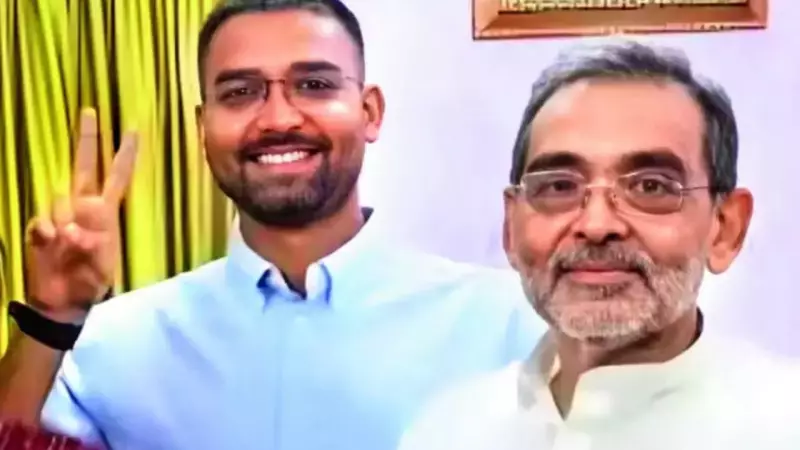
The political future of Bihar's Panchayati Raj Minister, Deepak Prakash, is now shrouded in uncertainty. This crisis stems from an impending split within the Rashtriya Lok Morcha (RLM), the party founded and led by his father, former Union minister Upendra Kushwaha. The rebellion threatens to upend the junior Prakash's nascent political career and could dim his father's prospects for another term in the Rajya Sabha.
The Root of the Rebellion: A Ministerial Berth for a Non-Legislator
The core of the discontent lies in the surprising decision by Upendra Kushwaha to nominate his son, Deepak Prakash, for a ministerial position in Chief Minister Nitish Kumar's cabinet. This move was made from the RLM's quota, despite Deepak not being a member of either house of the Bihar legislature. The appointment bypassed other senior party figures, including Kushwaha's wife and Sasaram MLA, Snehlata.
This dynastic maneuver has ignited fury among three of the party's four legislators. The MLAs—Rameshwar Mahto (Bajpatti), Madhav Anand (Madhubani), and Alok Kumar Singh—view the decision as a betrayal of principles. According to the Constitution, Deepak Prakash must become a member of the state legislature within six months of his appointment to continue as a minister. Typically, this is achieved through a nomination to the Legislative Council (MLC). However, if the RLM splits and the rebel MLAs leave, neither the BJP nor the Janata Dal (United)—the two major partners in the ruling NDA—would be inclined to facilitate his MLC nomination.

MLAs Voice Their Discontent and Threaten Exit
The resentment has moved from private grumblings to public defiance. The three disgruntled MLAs conspicuously skipped a recent "litti party" hosted by Kushwaha. Instead, they chose to meet Nitin Nabin on the same day, following his appointment as a BJP national working president, signaling their alignment with other power centers within the NDA.
Bajpatti MLA Rameshwar Mahto was particularly scathing in his criticism. He stated that the decision to make Deepak a minister was fundamentally wrong. "I came with Kushwaha for his stand against dynastic politics. I could never imagine that he is floating the party for ‘Parivar’ politics," Mahto said, expressing his disillusionment. He emphasized that his entry into politics was to serve the poor, not to promote family interests.
While Madhubani MLA Madhav Anand, speaking from Delhi, offered a more conciliatory tone by claiming the party is united and open to discussion, the actions of the trio suggest a deeper rift. They have collectively stated that while they are united in their stance, a final decision on whether to leave the party is pending.
Broader Implications for Kushwaha and RLM's Future
The potential split carries severe consequences beyond Deepak Prakash's cabinet position. Upendra Kushwaha's own Rajya Sabha membership is set to expire in April, coinciding with five Bihar seats in the Upper House falling vacant. A weakened and splintered RLM would significantly reduce his chances of securing a renomination from the NDA, leaving his political career at a crossroads.
This turmoil marks a dramatic downturn for Kushwaha, who served as Union Minister of State for Education in the first Modi government from 2014 to 2019. His political fortunes had seen a minor revival in the November 2025 Bihar assembly elections, where the RLM managed to win four seats. However, the current crisis threatens to undo that fragile recovery.
Despite the open rebellion, RLM chief spokesman Ram Pukar Sinha maintains that the party remains united and is working to strengthen itself. This official stance, however, stands in stark contrast to the very public airing of grievances by its elected representatives. The coming weeks will be critical in determining whether the Rashtriya Lok Morcha can survive this internal revolt or if it will fracture, reshaping a small but significant part of Bihar's political landscape and ending a minister's tenure almost as soon as it began.