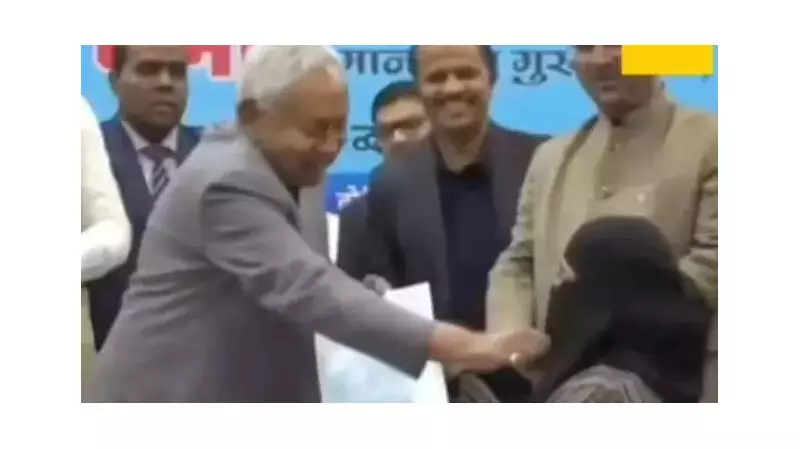
A recent incident involving Bihar Chief Minister Nitish Kumar has ignited a fierce political debate hundreds of miles away in Jammu and Kashmir. The controversy stems from Kumar's act of removing the face veil, or niqaab, of a Muslim woman during a public function.
Omar Abdullah's Sharp Retort and Historical Parallel
Addressing reporters on the sidelines of a tourism conference in Srinagar, Jammu and Kashmir Chief Minister Omar Abdullah launched a pointed attack. He did not limit his criticism to Nitish Kumar but also dragged former J&K Chief Minister and Peoples Democratic Party (PDP) president Mehbooba Mufti into the fray.
Omar Abdullah accused Mehbooba Mufti of committing a similar "unsecular act" years ago by removing the burqa of a legitimate voter inside a polling station. "Have you forgotten the way Mehbooba Mufti removed the burqa of a legitimate voter inside a polling station years ago? The Bihar CM’s act is a continuation of that. We have seen it before," Abdullah stated.

He expressed regret over both incidents, labeling them as unfortunate. The J&K CM also took a dig at Nitish Kumar's shifting political image, remarking, "Earlier, Nitish Kumar was considered a secular leader, but he is now slowly showing his true colours."
Peoples Democratic Party's Furious Backlash
The PDP responded swiftly and strongly to Omar Abdullah's comments. Party spokesperson Mohit Bhan turned the tables, accusing Abdullah of complicity. "Nitish Kumar humiliates a Muslim woman in public and Omar responds by attacking Mehbooba Mufti. This is his complicity," Bhan asserted.
The criticism grew even more personal and severe from Mehbooba Mufti's daughter, Iltija Mufti. She described the Chief Minister's remarks as "shameful." In a sharp condemnation, Iltija said, "How shameful stepping in to defend a man who pulls a Muslim woman’s niqaab in full public view. Complicit and covert allies working in tandem."
She further escalated the charge, alleging that Omar Abdullah, as the CM of India's only Muslim-majority state, was "openly advocating for Indian Muslims to be second class citizens."
Analyzing the Political Fallout and Secular Discourse
This war of words highlights how a localized incident in Bihar has been weaponized in the complex political landscape of Jammu and Kashmir. The debate has shifted from the original act to a broader contest over secular credentials and political one-upmanship.
Omar Abdullah's strategy appears to be an attempt to deflect sole criticism from Nitish Kumar by reminding the public of a comparable action by his political rival, Mehbooba Mufti. However, the PDP's reaction frames Abdullah's response as a deflection from condemning the primary act of humiliation against a Muslim woman.
The core issue of women's agency, religious expression, and the conduct of public figures towards citizens remains central, even as it gets entangled in partisan politics. The incident raises significant questions about the boundaries of personal liberty and the symbolism of such acts by those in power.
As the political blame-game continues between the National Conference and the PDP, the controversy underscores the sensitive interplay between identity, politics, and secularism in contemporary Indian discourse.