Bengal BJP Unveils Major Welfare and Industrialization Agenda Post-Election Schedule Announcement
In a significant political move following the Election Commission's declaration of the poll schedule on Sunday, West Bengal BJP president Samik Bhattacharya has laid out an ambitious roadmap for the state, should his party assume power. The announcements, made during a media address in Kolkata, center on substantial financial commitments to women and government employees, alongside a blueprint for economic revitalization through industrialization.
Financial Promises: Annapurna Yojana and Pay Commission Implementation
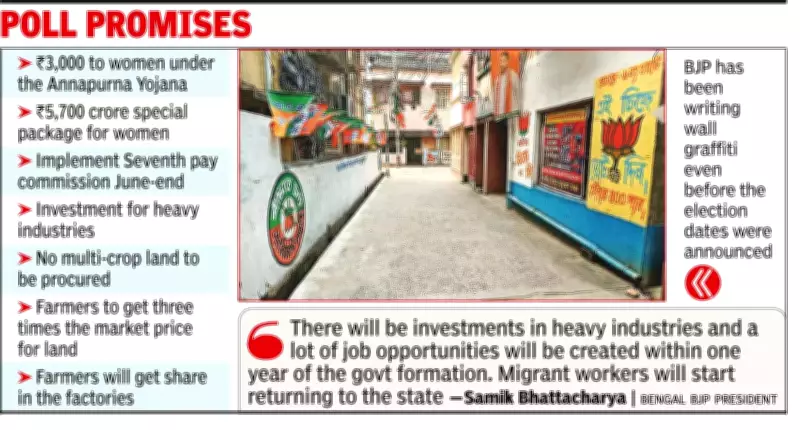
Samik Bhattacharya pledged that a BJP-led government would provide Rs 3,000 per month to women under the proposed Annapurna Yojana scheme. This promise was reiterated multiple times during his speech, emphasizing its centrality to the party's manifesto. Additionally, he announced a special economic package valued at Rs 5,700 crore specifically targeted at women's welfare.
For state employees, Bhattacharya committed to the immediate implementation of the 7th Pay Commission upon forming the government. "The new government will be established by the second week of May, and we will operate from the Writers' Building," he stated confidently, outlining a swift transition to enact these financial measures.
Vision for Governance and Industrial Growth
Bhattacharya articulated a vision of inclusive governance, asserting that the BJP would restore the rule of law and reject divisive politics. "It will be an inclusive government that does not believe in the politics of division and hatred," he declared, positioning his party as a unifying force in West Bengal.
The BJP's economic strategy focuses on rapid industrialization and balanced development. Bhattacharya emphasized that a BJP administration would equally prioritize agriculture and industry, aiming to attract investments in heavy industries to generate substantial employment opportunities within the first year. This initiative is expected to encourage migrant workers to return to the state as job prospects improve.
Land Acquisition Policy and Critique of Dole Politics
Addressing the sensitive issue of land acquisition for industrial projects, Bhattacharya outlined a farmer-friendly approach. He assured that multi-crop land would not be acquired, and farmers would receive three times the market price for any land taken, along with doubled solatium and a share in the projects. This policy is designed to mitigate opposition and ensure fair compensation.
Interestingly, Bhattacharya downplayed the effectiveness of dole politics, suggesting that financial assistance alone does not secure voter loyalty. "Dole does not ensure allegiance to a party. Those who receive it know it is sourced from their own money," he remarked, indirectly critiquing rival Trinamool Congress's Lakshmir Bhandar scheme. He pointed to the BJP's performance in panchayat polls as evidence that welfare schemes are not the sole determinant of electoral success.
Election Process and Electoral Roll Confidence
Welcoming the Election Commission's decision to conduct the elections in two phases, Bhattacharya expressed satisfaction that the special intensive revision of electoral rolls was not halted prematurely. He acknowledged past challenges, including violence and non-cooperation from the state government during the revision process, but affirmed his faith in the ECI to deliver an error-free electoral roll, ensuring a fair and transparent election.
These announcements mark a strategic effort by the Bengal BJP to consolidate support among key demographics—women and government employees—while presenting a comprehensive economic development plan ahead of the crucial state elections.