
The Assam government has embarked on a controversial new strategy to address the long-standing issue of illegal immigration by reviving a legislation that had lain dormant for over seven decades. The state is invoking the Immigrants (Expulsion from Assam) Act of 1950 to order individuals declared as foreigners by Foreigners' Tribunals to leave India, often within days, effectively bypassing the lengthy legal appeal process.
The Revival of a Dormant Law
In a significant policy shift, the Assam Cabinet last year approved a Standard Operating Procedure (SOP) to implement the IEAA. The first orders under this revived act were issued in November 2025 against five individuals from Sonitpur district. This was followed by another order in December against 15 people from Nagaon district, who were subsequently moved to a location near the Bangladesh border.
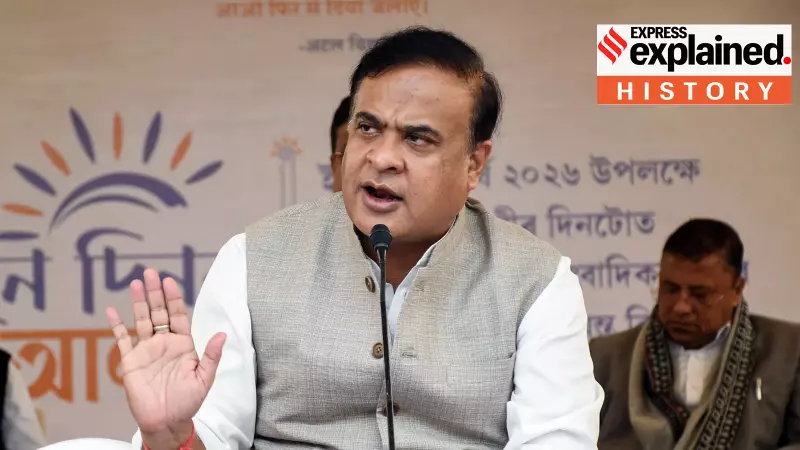
Chief Minister Himanta Biswa Sarma has been vocal about the government's intent. He stated that the 1950 law allows the state to expel declared foreigners "within a week" of a Tribunal's order, before the individual can file a legal challenge in higher courts. This process starkly contrasts with the existing route, where individuals can appeal to the Gauhati High Court and the Supreme Court, and deportation requires formal verification and handover procedures with the neighboring country.
What is the Immigrants (Expulsion from Assam) Act?
Enacted on March 1, 1950, the IEAA was a Central law drafted in response to pressure from the Assam government of the time to control migration from East Pakistan after Partition. The law empowered the government to direct any person, ordinarily resident outside India, to leave Assam or India if their stay was deemed "detrimental to the interests of the general public" or of any Scheduled Tribe in Assam.
However, its initial application was short-lived. Historian Arupjyoti Saikia notes in his book that the Act created complications, even for some original residents. Its use was effectively halted by Prime Minister Jawaharlal Nehru in April 1950, following the Nehru-Liaquat Pact which aimed to protect minorities. Nehru wrote to then Assam Chief Minister Gopinath Bordoloi to stop all action under the IEAA, prioritizing peace and control over the situation.
Legal Bypass and Future Plans
The revival of this Act provides the state with a legal framework for its recent practice of "pushing back" declared foreigners across the international border without formal diplomatic procedures. CM Sarma has claimed that the Supreme Court directed the state to employ this Act. He has explicitly stated that this move bypasses the need for a deportation treaty with Bangladesh.
Setting ambitious targets, Sarma announced, "We can now expel from 10,000 to 50,000 foreigners, if we can identify them." He framed this as a defining mission for his government's next term, stating that while evictions from government land were a hallmark of the last five years, the expulsion of foreigners would be the hallmark of the next five.
The move has already faced legal challenges. Families of at least one of the individuals ordered for expulsion have approached the Supreme Court, while another has moved the Gauhati High Court, setting the stage for a significant legal confrontation over the state's powers and the rights of the accused.