
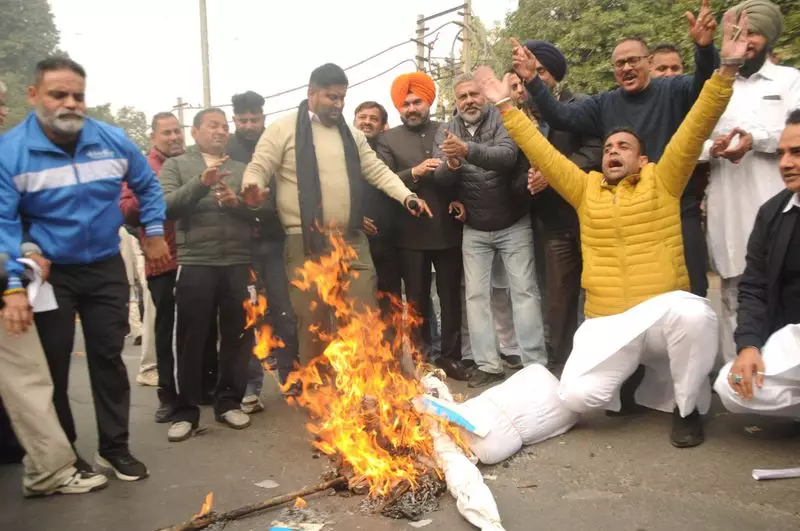
Workers of the Indian National Congress in Amritsar took to the streets on Tuesday, staging a vociferous demonstration against the contentious Government of National Capital Territory of Delhi (Amendment) Bill, 2023. The protest culminated in the symbolic burning of an effigy of Prime Minister Narendra Modi, reflecting the intense political opposition to the proposed legislation.
Fiery Demonstration in the Holy City
The protest was organized by the Amritsar District Congress Committee, drawing a significant number of party workers and local leaders. Gathering at the historic Hall Bazaar, the demonstrators voiced their strong condemnation of the bill, which they argue severely curtails the powers of the elected government of Delhi. The protesters carried placards and raised slogans against the central government, accusing it of undermining federal principles and democratic norms.
The key point of contention is the bill's provision to hand over control of 'services' in Delhi to a centrally-appointed authority. Congress leaders at the protest asserted that this move effectively strips the elected Chief Minister and his council of ministers of their authority over bureaucrats, rendering the state government powerless. They framed the bill as a direct assault on the democratic rights of the people of Delhi.
Symbolic Burning of Effigy and Political Condemnation
The most dramatic moment of the protest was when the gathered Congress workers set fire to an effigy representing Prime Minister Narendra Modi. This act symbolized their fury and frustration with what they perceive as the central government's repeated attempts to bypass and weaken opposition-led state governments.
Senior Congress leaders addressed the crowd, linking the GNCTD Bill to a broader pattern of centralization of power. They criticized the Bharatiya Janata Party (BJP)-led central government for using its majority in Parliament to pass laws that, in their view, distort the constitutional balance between the Centre and the states. The protest in Amritsar is part of a wider chorus of opposition to the bill, which has been vehemently criticized by the Aam Aadmi Party (AAP) government in Delhi as well.
National Implications and Local Resonance
While the bill specifically concerns the administration of the national capital, the protest in Punjab's Amritsar highlights its national political significance. The Congress party is leveraging the issue to galvanize its base and position itself as a defender of state rights against an overreaching Centre. The choice of Amritsar, a major urban center in Punjab, underscores the party's attempt to keep the issue alive in public discourse beyond Delhi.
The passage of the GNCTD (Amendment) Bill by Parliament last week has solidified it as a major flashpoint in Indian federal politics. The protest in Amritsar signals that the Congress intends to keep the pressure on the government over this issue, potentially using it as a rallying cry in the lead-up to future elections. The visual of the burning effigy ensures the message is stark and reaches a wide audience, amplifying their political dissent.
As the bill awaits the President's assent to become law, political tensions surrounding it are likely to persist. The Amritsar protest serves as a clear indicator that opposition parties will continue to challenge the legislation both inside and outside the legislative chambers, framing it as a battle for the soul of Indian democracy and the rights of elected state governments.