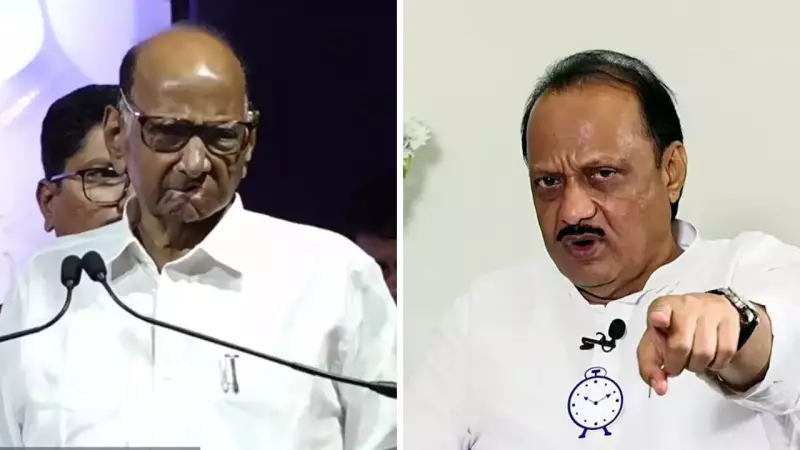
In a dramatic political development that has sent ripples across Maharashtra's political landscape, the two rival factions of the Nationalist Congress Party (NCP) led by Ajit Pawar and Sharad Pawar have decided to join hands for the upcoming civic body elections in the Pune region. This marks a notable, albeit localized, reunion of the uncle-nephew duo who had parted ways two years ago.
A Strategic Alliance for Local Polls
Announcing the electoral tie-up, Maharashtra Deputy Chief Minister Ajit Pawar stated that the alliance is specifically restricted to the Pimpri-Chinchwad Municipal Corporation (PCMC) and Pune local body elections. He described it as a "local arrangement" driven by developmental goals. "For the sake of the Pimpri-Chinchwad Municipal Corporation elections, the 'clock' and the 'tutari' (trumpet) have united. The parivar has come together," Ajit Pawar declared.
He further emphasized their intent to focus on development, stating, "We are the ones who work for development. We will edge out those who tried to put this municipal corporation in debt."
Echoing this sentiment, NCP(SP) MLA Rohit Pawar clarified that the decision was a response to the demands of party workers, calling the upcoming polls a "fight of the workers." He revealed that after extensive consultations with grassroots workers, including an interaction led by Supriya Sule, it was decided to contest together in Pune and Pimpri-Chinchwad. However, he stressed that both parties will contest on their respective symbols—the 'clock' for Ajit's faction and the 'tutari' for Sharad Pawar's group.
Rohit Pawar also clarified that Sharad Pawar was not directly involved in the decision-making process for these municipal elections, as such senior leaders typically do not participate directly in corporation polls.
Ripples in the Opposition Alliance
This unexpected alliance has caused unease within the opposition Maha Vikas Aghadi (MVA) coalition. Shiv Sena (UBT) MP Sanjay Raut demanded an explanation from Sharad Pawar, questioning the consistency of his stance. "Sharad Pawar needs to answer this, as he has always opposed the BJP, but now they are going with them," Raut remarked during a media briefing.
Earlier, Shiv Sena leader Sanjay Shirsat hinted that this local-level adjustment could be a precursor to a broader political understanding, even suggesting a possibility of NCP (SP) joining the BJP-led NDA government in the future.
Background of the Feud and Its Aftermath
The current alliance is a stark contrast to the events of two years ago when Ajit Pawar, along with several senior leaders, split from his uncle Sharad Pawar and allied with the BJP and Eknath Shinde's Shiv Sena to become part of the Maharashtra government. Ajit had then raised objections about Sharad Pawar continuing to lead the party despite his age.
The Election Commission later recognized Ajit's faction as the legitimate NCP, awarding it the party's original 'clock' symbol. Sharad Pawar's faction, now called NCP (Sharad Pawar) or NCP-SP, adopted the 'tutari' (curved trumpet) as its symbol.
Following the 2024 Lok Sabha elections, where his faction faced setbacks, Ajit Pawar publicly acknowledged that turning his back on family had been a "mistake." However, he had initially justified his move by stating he joined the NDA to "ensure stability and progress in Maharashtra."
The political divide was clearly reflected in the 2024 Maharashtra assembly elections. The BJP-led Mahayuti alliance secured a massive victory with 235 seats, including 41 for Ajit Pawar's NCP. In contrast, the Maha Vikas Aghadi was reduced to 46 seats, with Sharad Pawar's NCP(SP) winning only 10. Ajit's faction notably defeated the senior Pawar's nominees in 27 out of 34 head-to-head clashes.
While the new pact is currently limited to the civic polls in the Pune region, it has undoubtedly opened a new chapter in the complex Pawar family saga and Maharashtra politics, leaving observers to speculate on its long-term implications for state and national alliances.