AIUDF's Political Crossroads in Assam: A Battle for Relevance
In the dynamic political landscape of Assam, the All India United Democratic Front (AIUDF) and its prominent leader, Badruddin Ajmal, find themselves at a critical juncture. Following a strong performance in the 2021 assembly elections, where they secured 16 seats, the party appeared poised as a significant counterforce to Chief Minister Himanta Biswa Sarma. At that time, AIUDF symbolized the political mobilization of Assam's Bangladeshi-origin Muslim immigrants, often referred to locally as 'miyas'. However, the political tides have shifted dramatically over the past five years, presenting formidable challenges to the party's future.
Electoral Setbacks and Changing Alliances
A series of developments have reshaped AIUDF's standing. The party is no longer aligned with the Congress, marking a significant shift in Assam's opposition dynamics. Furthermore, Badruddin Ajmal suffered a substantial personal defeat in the 2024 Lok Sabha elections, losing his Dhubri constituency to Congress by a margin exceeding 10 lakh votes. This loss has notably diminished his political aura and influence. Compounding these challenges, the recent delimitation exercise has altered electoral arithmetic in traditional AIUDF strongholds, potentially reducing the number of seats where Muslim voters hold decisive sway. AIUDF general secretary Champak Kalita has criticized this delimitation as "unconstitutional," highlighting its impact on the party's prospects.
Internal Assessment and External Pressures
Within AIUDF circles, the assessment following Ajmal's 2024 defeat suggests the party is experiencing its weakest phase since its inception in 2006. Kalita acknowledges that Ajmal lost his bastion during a national wave where approximately 91% of Muslims voted for the INDIA bloc. However, he points to Congress's subsequent loss of momentum after defeats in states like Bihar, arguing that AIUDF can capitalize on this shift. "After losing Dhubri, public opinion was not in our favour," Kalita states. "But after the Bihar election, there has been a paradigm shift. Momentum has returned and people now feel Congress has weakened and cannot form government. They are returning to AIUDF. We have regained ground."

The party is contesting 29 seats in the upcoming elections and aims to win 22-25, reflecting cautious optimism amidst adversity. Meanwhile, emerging political forces like the Akhil Gogoi-led Raijor Dal, founded just five years ago, are seen as eroding AIUDF's traditional support base among Muslim voters.
Community Dynamics and Political Observations
Political observers note that AIUDF faces an uphill battle. Retired Brigadier Ranjit Borthakur, a former military intelligence officer and political analyst, remarks that Ajmal and AIUDF "certainly have their backs against the wall." He highlights that Muslims rejected Ajmal in the Lok Sabha election even in his own backyard. Borthakur also raises questions about AIUDF's voting for an NDA candidate in the Rajya Sabha, suggesting possible understandings with Sarma. "Ajmal's popularity has waned because he projected himself as representative of the miya community but has not been successful in delivering much. People have realised this," Borthakur explains. "Secondly, many miya families have benefited from the BJP government's welfare schemes. A section of Muslims here might vote in favour of BJP."
It is important to contextualize the term 'miya,' which locally refers to Bangladeshi-origin Muslim immigrants, distinguishing them from indigenous Muslim communities such as Gorias, Moriyas, Jolhas, Deshis, and Syeds. These indigenous groups number around 40 lakh, constituting approximately one-third of Assam's total Muslim population.

Strategic Moves and External Support
As Ajmal recalibrates his strategy, he has returned to Binnakandi, the reconfigured post-delimitation constituency formerly known as Jamunamukh, where he made his assembly debut in 2006. This constituency retains its Muslim-majority demographic character, offering a potential stronghold. Kalita emphasizes the importance of Ajmal's presence in the assembly: "When he is in the assembly and all our other MLAs are standing behind him, Sarma will not have the courage to abuse miyas." Regarding post-election scenarios, Kalita adds, "If a non-BJP government is formed, AIUDF will extend unconditional support. If BJP wins, our MLAs will protest and stand up against any injustice done like eviction of Muslim people."
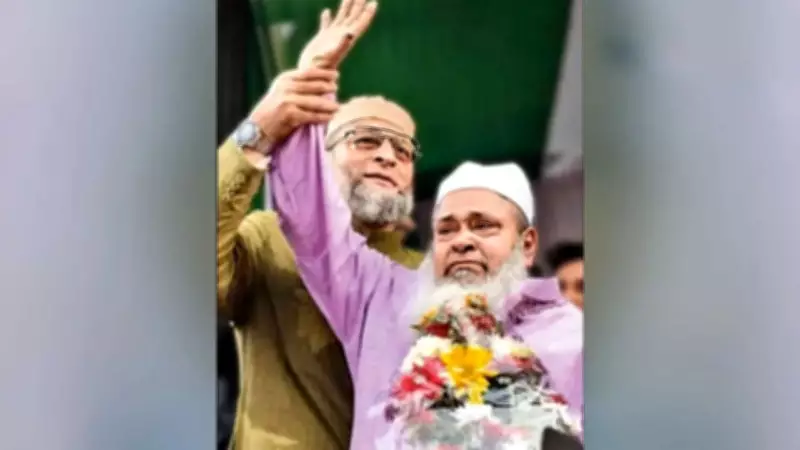
External support has emerged from AIMIM president Asaduddin Owaisi, who is campaigning extensively for Ajmal. His rallies have drawn large crowds chanting "miya zindabad" slogans. Owaisi states, "I have come to Assam for a special purpose. To speak for the rights and protection of miya Muslims." At a rally in Binnakandi, he accused the BJP of indulging in "hate politics" and criticized Congress for remaining "silent" against it. He also condemned the state government's eviction drives as "unconstitutional" and "a violation of human rights."
Historical Parallels and Future Prospects
The current scenario echoes a historical precedent from four decades ago. In 1985, the United Minorities Front (UMF) emerged after the Assam Accord, making a strong debut with 17 seats. However, by 2001, it failed to win any seats, and in 2005, its leaders joined the newly formed AIUDF. This history serves as a cautionary tale for AIUDF as it navigates its own survival battle.
As the 2026 assembly elections approach, AIUDF's journey reflects the complex interplay of identity politics, electoral arithmetic, and shifting alliances in Assam. With Ajmal's resilience tested and the party's base under pressure, the outcome will significantly influence the state's political trajectory and the representation of its Muslim communities.