AAP Launches Statewide Demonstrations in Punjab Over Alleged Derogatory Remarks
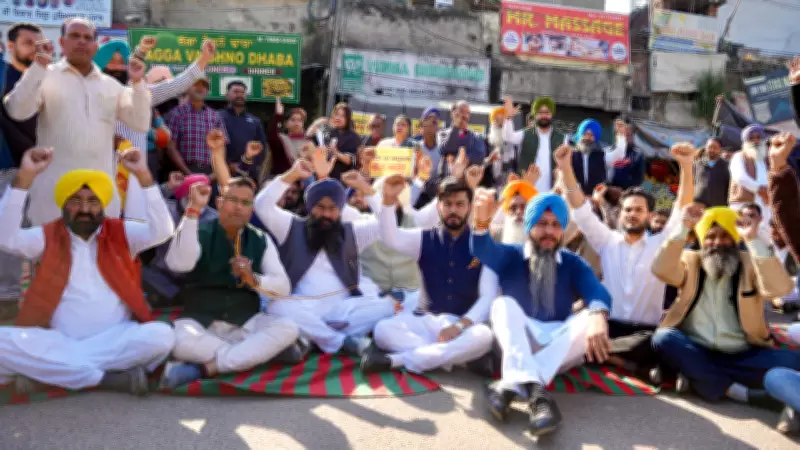
The Aam Aadmi Party (AAP) organized coordinated protests across multiple districts in Punjab on Friday, targeting offices of the district Congress committees and residences of Congress leaders. This widespread mobilization was a direct response to alleged remarks made by Leader of the Opposition in the Punjab Assembly, Partap Singh Bajwa, against state minister Harbhajan Singh.
Symbolic Demonstrations and Political Confrontation
Led by prominent AAP figures including ministers and sitting MLAs, party members conducted sit-in demonstrations while chanting slogans condemning Bajwa's comments. In a particularly symbolic gesture, the ruling party arranged for a traditional wedding band to perform during the protests in Hoshiarpur, directly countering Bajwa's alleged reference to Harbhajan Singh's family background in band music.
Addressing the gathering in Hoshiarpur, AAP leaders characterized Bajwa's comments as "unfortunate and unacceptable" while demanding a formal apology. They declared their intention to continue opposing Bajwa on this matter during the upcoming Budget session of the Punjab Assembly, signaling an escalation in political tensions.

The Controversial Remarks and Their Aftermath
The controversy stems from Bajwa's accusations of corruption against Minister Harbhajan Singh, coupled with his statement that the Congress would hold him accountable upon forming government. Bajwa had reportedly said in Punjabi: "Jehra pehle band vajaanda reha, ehda band asin vajaavange" (He who used to be a band player will be taken to task by us), directly referencing Singh's family background.
In response, Harbhajan Singh criticized Bajwa for what he described as mocking honest livelihoods, noting that his father worked as a bandmaster who educated his children through diligent effort. The Punjab State Scheduled Castes Commission chairman Jasvir Singh Garhi took suo motu notice of Bajwa's remark, though Bajwa's counsel later denied that any objectionable comments were made against the minister.
Broader Implications and Cultural Dimensions
Deputy Speaker of the Punjab Assembly Jai Krishan Singh Rouri, who participated in the Hoshiarpur protest, emphasized that such language was unbecoming of a Leader of the Opposition. "In a democratic system, it is not appropriate to make comments on someone's background or profession. Such language has no place in Punjab," Rouri told reporters.
Rouri further elaborated that Bajwa's remarks had offended working-class sentiments across the state, highlighting that Harbhajan Singh's rise from humble origins through hard work should be celebrated rather than disparaged. "The band is traditionally associated with celebrations and the dignity of labour. Targeting someone for such work reflects a narrow mindset," he asserted, adding that political opposition should focus on substantive issues rather than personal attacks.
Statewide Protest Locations and Leadership
The demonstrations extended beyond Hoshiarpur to multiple strategic locations:
- In Ludhiana, Minister Hardeep Singh Mundian led protests outside the office of Punjab Congress chief Amrinder Singh Raja Warring
- Additional demonstrations occurred in Sri Muktsar Sahib, Moga, Bathinda, Amritsar, and Jalandhar
- At several sites, protests were staged outside the homes of Congress leaders, intensifying the political confrontation
Minister Mundian joined other AAP leaders in condemning the language used by Congress representatives, framing the issue as one of respect for professions and personal backgrounds versus derogatory political rhetoric. The widespread nature of these protests underscores the AAP's organizational reach and its determination to defend party members against perceived personal attacks.
This incident has sparked broader conversations about political discourse in Punjab, with implications for upcoming legislative sessions and inter-party relations. The involvement of constitutional bodies like the Scheduled Castes Commission further elevates the significance of this controversy beyond routine political sparring.