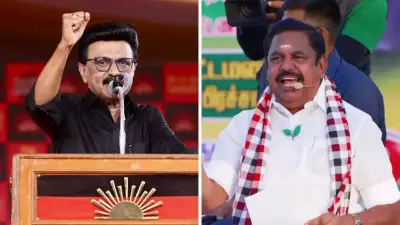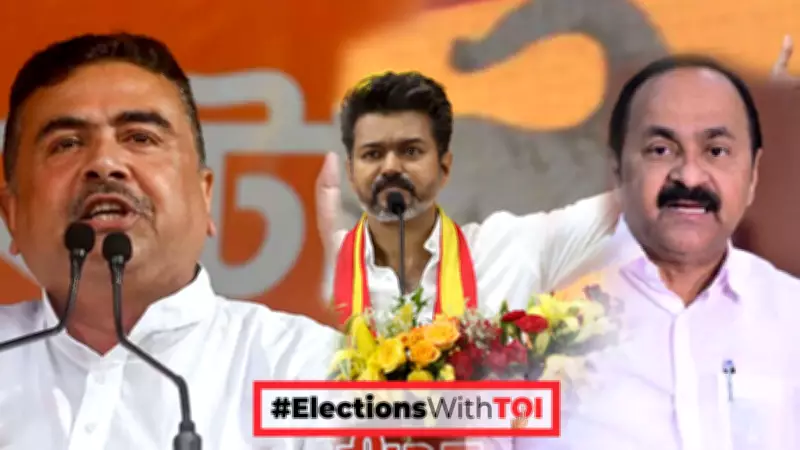
The 2026 Assembly election results across Tamil Nadu, West Bengal and Kerala indicate a significant political shift, with voters moving away from established power structures. In Tamil Nadu, a major disruption has occurred as Vijay’s Tamilaga Vettri Kazhagam (TVK) emerged as a strong force challenging the traditional dominance of the DMK and AIADMK. The verdict reflects an evolving voter preference for change, governance, and new political narratives.
Tamil Nadu: TVK Breaks DMK-AIADMK Duopoly
Tamil Nadu witnessed a historic shake-up as the TVK, led by actor-turned-politician Vijay, secured a commanding lead in over 100 seats, effectively breaking the decades-long duopoly of the DMK and AIADMK. This outcome signals a desire for fresh leadership and alternative governance models among the electorate. Security was beefed up at Vijay’s residence as celebrations erupted among TVK supporters, while the DMK was seen removing tents at Anna Arivalayam in response to early trends.
West Bengal: BJP Poised for Historic Breakthrough
In West Bengal, the BJP appears poised for a historic breakthrough, crossing the majority mark and leading in key constituencies. The ruling Trinamool Congress (TMC) faced widespread electoral setbacks, with early trends showing the BJP ahead in Bhabanipur and other strongholds. Political analysts noted that the 'Anti-Hindu' tag hurt the TMC, while the party’s 'Pro-Muslim' stance also backfired. BJP workers celebrated what they termed 'Ram Rajya' in Bengal, as the party held a majority lead over the TMC. Mamata Banerjee, in her first reaction, said, 'Will win after sunset,' even as the BJP crossed the majority mark. Security was heightened at Vijay’s residence in Tamil Nadu as TVK surged, while in Bengal, the counting process saw intense scrutiny.

Kerala: UDF Takes Clear Lead Over LDF
Kerala is set to return to its pattern of alternating governments, with the Congress-led United Democratic Front (UDF) taking a clear lead over the ruling Left Democratic Front (LDF). Shashi Tharoor called for a policy reset and economic revival following the verdict, emphasizing the need for new governance approaches. The result reflects a cyclical shift in voter preference, as the state continues its tradition of rejecting incumbents.
Implications and Analysis
The 2026 verdict across these three states underscores a broader trend of voters seeking change and accountability. In Tamil Nadu, Vijay’s political leap—drawing comparisons to MGR and NTR—has redefined the state’s political landscape. In West Bengal, the BJP’s surge suggests a consolidation of anti-incumbency sentiment against the TMC. Kerala’s swing back to the UDF indicates a desire for alternative policies. Overall, the elections signal a significant realignment in Indian state politics, with new narratives and leaders reshaping voter expectations.