

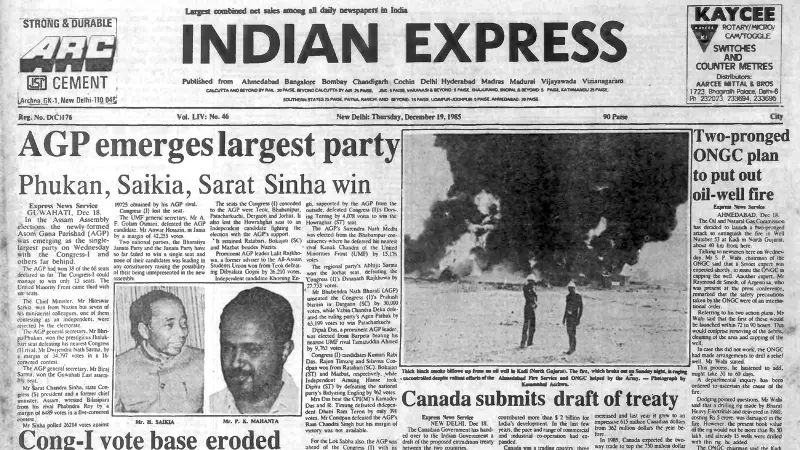
A historic day unfolded on December 19, 1985, marked by a political earthquake in Assam, a significant diplomatic development with Canada, and a critical emergency operation by India's oil authority.
AGP Storms to Victory in Assam Elections
The newly formed Asom Gana Parishad (AGP) emerged as the clear victor in the Assam Legislative Assembly elections. The party, riding a wave of regional sentiment, was declared the single largest party, leaving the incumbent Congress-I far behind in the tally.
As results for 68 seats were announced, the AGP had secured a commanding 38 seats. The Congress-I, led by Chief Minister Hiteswar Saikia, managed to win only 13 seats. The United Minority Front secured the third position with six seats. While CM Saikia himself won from the Nazira constituency, the election proved costly for his cabinet, as seven of his ministerial colleagues were defeated.

India and Canada Move Towards Extradition Treaty
In a major diplomatic step, the Canadian government handed over a draft of a proposed extradition treaty to India. The move was directly linked to addressing Sikh terrorist activities operating from Canadian soil.
Visiting Canadian Foreign Minister Joe Clark stated that his country viewed these activities as a security challenge for both nations. The proposed treaty aimed to establish a formal framework for the transfer of individuals accused of serious crimes, marking a concerted effort to bolster bilateral security cooperation.
ONGC's Two-Pronged Attack on Gujarat Well Fire
The Oil and Natural Gas Commission (ONGC) launched a high-stakes operation to extinguish a raging fire at Well Number 53 in Kadi, North Gujarat, located roughly 40 km from Ahmedabad.
ONGC Chairman S P Wahi outlined a two-phase action plan to journalists. The first phase, to be initiated within 72 to 90 hours, involved clearing debris, sanitizing the area, and finally capping the well. International expertise was enlisted for the task, with a Soviet expert expected to arrive shortly. Argentine expert Raymond de Smedt, present at the briefing, commended the ONGC's safety measures, stating they were of an international order.
International Tragedy: Philippine Ship Sinking
In a separate tragic incident, nearly 200 people were feared drowned after a passenger ship sank in the central Philippines. Coast guard sources reported that the vessel, bound for Palawan island, apparently succumbed to rough seas off the coast of Mindoro island, south of Manila. Only three survivors had been rescued from the estimated 200 passengers and crew on board.
The events of December 19, 1985, thus captured a spectrum of human endeavor—from democratic upheaval and diplomatic maneuvering to technological challenge and natural disaster.






