

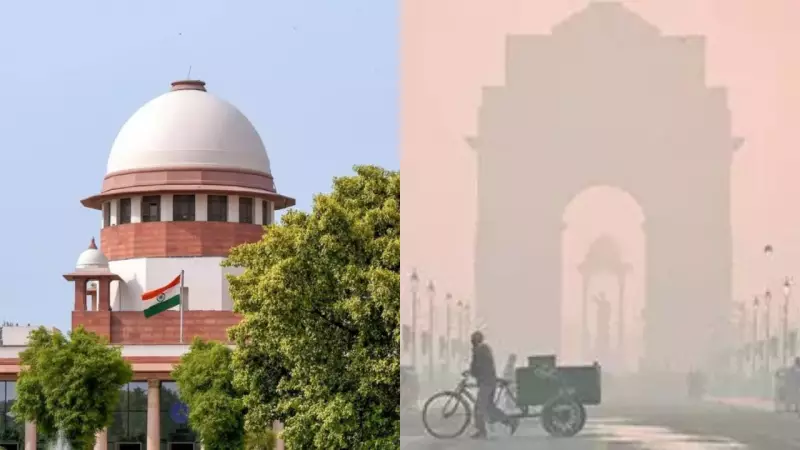
In a stark admission of policy failure, the Supreme Court of India on Tuesday declared that two decades of judicial and administrative intervention have failed to clean Delhi-NCR's toxic air. The court has now directed the Commission for Air Quality Management (CAQM) to urgently chart a new course.
Court Admits Past Failures, Seeks Concrete Roadmap
The bench, led by Chief Justice of India Surya Kant and including Justice Joymalya Bagchi, pointed to a critical flaw in past efforts. It observed that the court had previously relied on a multitude of conflicting expert opinions, which led to fragmented and ineffective orders. For instance, experts have variously attributed between 12% to 41% of the pollution load to vehicular emissions alone.
"This does not mean we will become experts and give knee-jerk orders like transition of all vehicles to electric. That'll cause chaos," the bench remarked. Instead, it tasked the statutory expert body, the CAQM, to consolidate all domain knowledge. "Why can't CAQM bring all domain experts under one roof, hold deliberations and come out with long-term solutions, which would be implemented in a phased manner so as not to hurt livelihoods, industry and the public?" the justices asked.

Two-Week Deadline for a Long-Term Plan
The court's directive comes with a tight and non-negotiable deadline. When Additional Solicitor General Aishwarya Bhati requested two months for the CAQM to prepare its report, the bench reacted sharply. It chastised the authority for a perceived lack of seriousness in tackling the perennial crisis of severe Air Quality Index (AQI) levels in the capital region.
The bench firmly stated, "We'll give two weeks to CAQM," ordering the commission to submit its comprehensive action plan by January 21. The court noted that it had previously, on December 17, asked the CAQM to revisit its long-term measures. However, the authority had only filed a status note instead of a concrete, actionable plan.
What the Supreme Court's Order Mandates
The CAQM's new mandate is clear and twofold. First, it must identify all major sources of pollution in the Delhi-NCR within the given fortnight. Second, based on this identification, it needs to suggest detailed, sector-specific long-term action plans to tackle each pollution source in a phased manner.
The court also expressed dissatisfaction with the CAQM's recent status report, calling it "unfortunately silent on several issues flagged by the court during the last hearing." In a specific instruction, the bench asked the commission to independently examine the issue of pollution related to toll plazas, without being influenced by the stands taken by the Municipal Corporation of Delhi (MCD), the Gurgaon civic body, or the National Highways Authority of India (NHAI).
This order marks a significant shift from the Supreme Court's earlier micro-management of the pollution crisis, pushing the onus firmly onto the dedicated statutory body to deliver a coherent, science-based, and sustainable roadmap for clean air.






