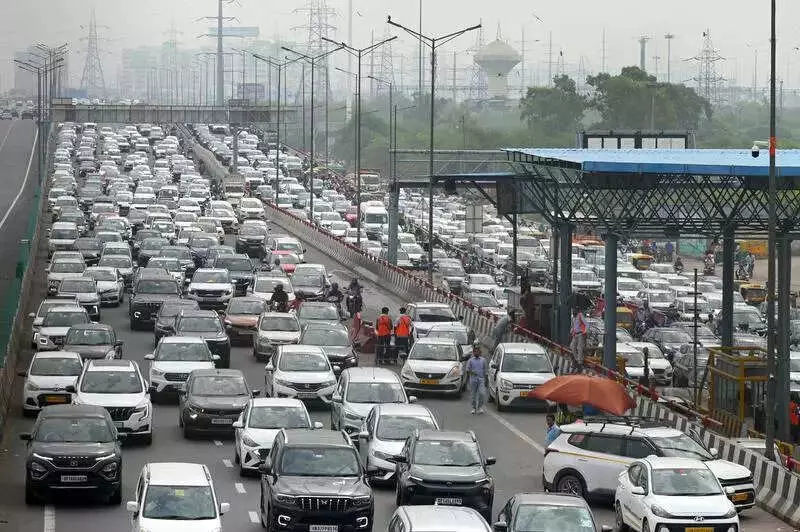
Commuters in the National Capital Region (NCR) have received a significant respite after the Supreme Court called upon government agencies to devise a plan for relocating nine toll plazas. These plazas, notorious for causing severe traffic congestion and escalating vehicle emissions, have long been a bottleneck for daily travel between NCR cities and the capital, Delhi.
The Epicenter of Chaos: Sirhaul Toll Plaza
The core of the problem lies at the Municipal Corporation of Delhi (MCD) toll plaza at Sirhaul on the Delhi–Gurgaon border. Here, a green tax is collected from commercial vehicles entering Delhi. With nearly 4 lakh passenger car units (PCUs) using the Delhi–Gurgaon Expressway daily, the impact is massive. The congestion is not limited to the plaza itself; on many evenings, the backlog stretches all the way to Cyber City, Atlas Chowk, and IFFCO Chowk in Gurgaon.
"Snarls start from Cyber City at rush hours. The moment traffic slows there, you know you are already late. I spend nearly four hours every day travelling between Delhi and Gurgaon. It's the same story every evening, with no improvement," said GD Mathur, an IT professional working in Cyber City. Even though private vehicles are exempt from the toll, they get no relief. The lack of segregated lanes forces cars to queue behind trucks and buses, locking all vehicles into the same choke point.

Broken System and Wider Disruptions
The tolling process itself compounds the gridlock. Unlike modern national highways, operations at Sirhaul remain largely manual. Toll staff scan vehicle registration numbers using mobile phones, slowing down every transaction. Delays worsen when cab drivers attempt to evade payment or when trucks are held up over disputes about charges or documentation.
This congestion has begun to severely disrupt travel planning, especially for air passengers. Anil Nanda, a resident of DLF 2, highlighted the challenge of reaching Delhi airport in the evening. "If you have a late evening flight, you can't rely on normal travel time anymore. Earlier, it took 30 to 45 minutes to cross this stretch. Now, you have to keep at least one-and-a-half hours in hand," he said, also pointing out the issue of rising emissions from idling vehicles.
The problem has now spilled beyond peak hours. Dhruv Bansal, from DLF 1, noted, "It took me more than two hours to reach a court in Delhi on a Tuesday. Traffic crawls past the toll plaza even in the morning now. Earlier, weekends were manageable. Now it doesn't matter whether it's a weekday or a weekend. You are guaranteed to get stuck."
Failed Solutions and Coordination Challenges
Authorities have attempted solutions with limited success. The Dwarka Expressway, opened last year to divert traffic, has seen a significant share of vehicles—especially commercial ones—return to the older route due to high toll charges. Furthermore, the RFID-based toll collection system, introduced after a Supreme Court order in August 2016, has failed to deliver seamless passage. Commuters report that benefits are diluted by frequent tag failures and the need for manual inspections to identify exempt vehicles, creating fresh bottlenecks.
The issue highlights a larger failure in NCR's integrated vision. Anurag Kulshrestha, founder of road safety NGO TRAX, stated that NCR was conceived to manage Delhi's expansion and enable seamless movement. "A few years ago, NCR-wide auto services were introduced, and there were plans for NCR taxis... However, due to poor coordination among state governments, these initiatives failed to take off," he explained.
The Gurugram Metropolitan Development Authority (GMDA) has held discussions with the National Highways Authority of India (NHAI) to examine decongestion measures for the Sirhaul stretch. However, for daily commuters like Jitendra Kumar from Sector 78, Noida, who gets stuck for nearly half an hour daily on the DND Flyway, the Supreme Court's intervention is a long-awaited step towards reclaiming the expressway's promised efficiency.