Facing a severe water crisis with depleting groundwater and heavy reliance on surface sources, the Rajasthan government has announced plans to introduce a stringent new law aimed at curbing water theft and ensuring fair distribution to authorized consumers. The move comes as the desert state grapples with securing its water future.
Addressing a Pressing Crisis
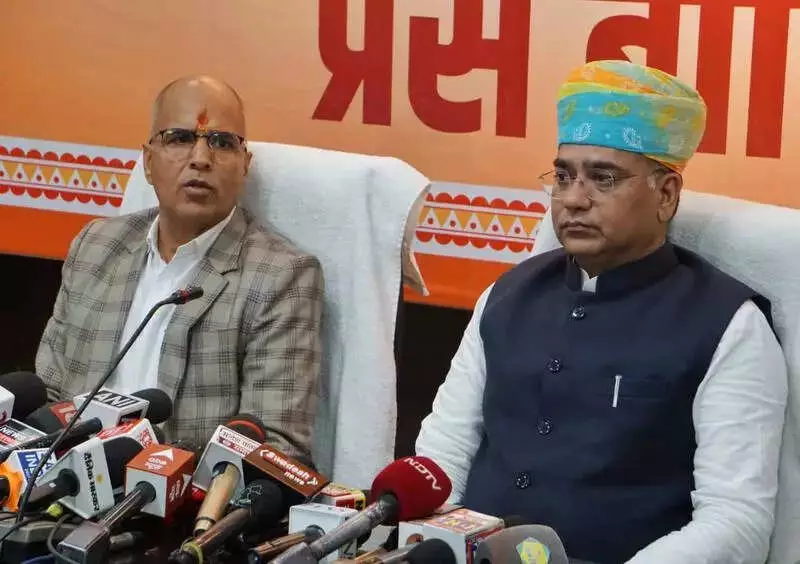
Public Health Engineering Department (PHED) Minister Kanhaiya Lal Choudhary made the announcement on Wednesday at a press conference held at Jal Bhawan, the PHED headquarters. He was joined by Water Resources Department (WRD) Minister Suresh Rawat to outline the water sector achievements of the present BJP government over the last two years.
"Rajasthan solely depends on surface water sources. The condition of the groundwater is not good," stated Minister Choudhary, highlighting the urgency of the situation. He emphasized that checking water theft has become critically important. "Soon, we are going to implement new sets of stringent laws to address such issues," he added, signaling a crackdown on unauthorized water usage.

Major Projects to Bolster Water Security
Alongside the legislative action, the ministers detailed several mega-projects designed to alleviate the state's water woes. WRD Minister Suresh Rawat provided significant updates on two key initiatives.
He revealed that the state government has issued work orders worth Rs 9,400 crore for the first phase of the Eastern Rajasthan Canal Project (ERCP), and construction is already in progress. Furthermore, survey work has commenced for the Ram Jal Setu Link Project, with work orders amounting to a substantial Rs 14,676 crore.
Rawat explained the transformative potential of these projects: "These works will ensure drinking water availability in eastern Rajasthan. The revised Parvati-Kalisindh-Chambal Link Project (new name for ERCP) will irrigate 4 lakh hectares of land and provide drinking water to approximately 3 crore people in 17 districts."
A Multi-Pronged Strategy for a Dry State
The government's approach appears to be two-fold: immediate regulatory action through stricter laws to manage existing resources efficiently, and long-term infrastructural solutions through ambitious canal projects. The mention of the Yamuna Water Project alongside the ERCP indicates a strategy to tap into and manage multiple surface water sources.
The planned stringent law is expected to target illegal extraction and distribution, ensuring that water reaches its intended, authorized consumers. This is particularly crucial in a state where equitable distribution can mean the difference between water security and severe scarcity for many communities.
The announcements from Jaipur underscore the government's recognition of the water crisis as a top priority. The combination of legislative muscle and massive financial investment in infrastructure represents a comprehensive attempt to secure Rajasthan's water future for its citizens and agriculture.