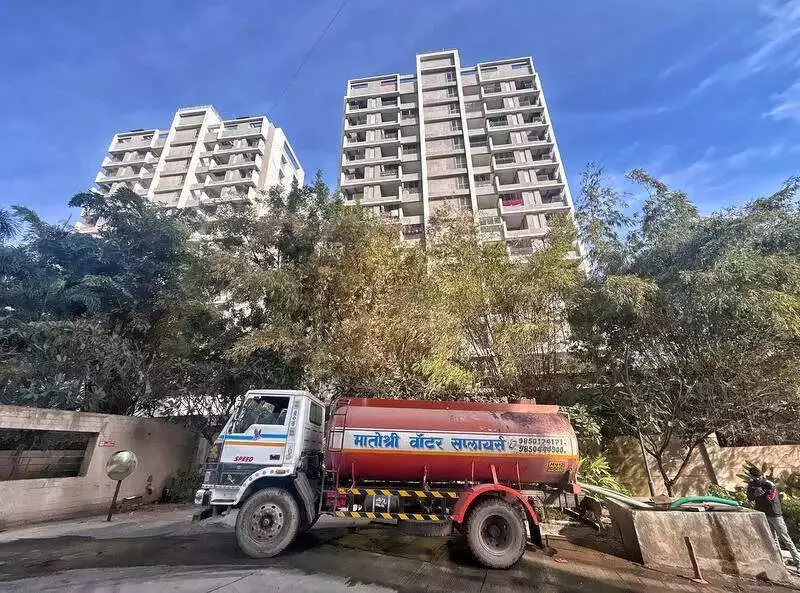
In a paradox that has left citizens frustrated and financially drained, several areas of Pune and Pimpri Chinchwad are grappling with a severe water crisis at the start of the year, despite nearly seven months of significant rainfall in 2025 that led to overflowing dams supplying the city.
Neighbourhoods Parched Despite Promises
Residents from Aundh Road, Kharadi, Bavdhan, Mhalunge, Tathawade, Model Colony, and Kalyaninagar have reported interrupted and poor water supply for at least the last month. The situation highlights a critical disconnect between rampant urban development and the corresponding upgrade of civic infrastructure, placing immense stress on resources and public finances.
Broken Infrastructure, Broken Promises
The crisis manifests in two ways: either the water infrastructure is missing entirely, or it exists but fails to deliver. Mahesh Gupta, a resident of Agnes co-operative housing society on Aundh Road, stated that although a functional PMC overhead tank is just 400 meters away, his society of 16 flats frequently goes without water. "We have raised the issue multiple times over four years, but officials are not resolving it," he said. The society, unable to afford regular tankers, relies on local political representatives for help.

In Bavdhan, Amol Chaudhare of Stargaze society explained that their area still depends on pre-merger gram panchayat pipes, receiving water for only one-and-a-half hours daily at low pressure. Despite this, their 660-flat society spends nearly Rs 6.5 lakh per month on tankers, over and above the water tax paid to PMC. "Infrastructure should be built before builders get permission or residents move in," Chaudhare emphasized.
The Crushing Financial Burden
The water scarcity has translated into an exorbitant financial burden for housing societies. Vinayak Kale from Aldea Espanola in Mhalunge revealed that almost 60% of their society's annual budget is spent on purchasing water. His society's Phase 2, with 188 flats, spends Rs 6-7 lakh monthly on tankers, despite having a PMC pipeline connection that delivers no water.
Peripheral areas like Kharadi, Wagholi, and Undri are hit hardest. Mahzabin Saiyed, a Kharadi resident, presented data from 33 societies showing a collective monthly tanker expenditure of around Rs 1 crore. In a meeting on September 3, 2025, following Bombay High Court directives, she highlighted that 30-35% of an average society's budget in Kharadi goes towards buying water. "Despite repeated requests, there has been no solution," she said, also raising concerns about water quality after a tanker was found supplying STP water in December 2024.
Deepak Patil, Chairman of the Kharadi Housing Societies Welfare Association, accused the PMC of focusing only on timely tax collection while ignoring service delivery. Sonu Gajeralwar Vashi from a society on NIBM Road pointed out the injustice: "We have 248 flats and get only 3,000 litres of water when we should get 40,000 litres for the tax we pay."
A "Man-Made" Scarcity and Official Response
Advocate Satya Muley, who filed the 2022 PIL on water scarcity, called the situation a "man-made" result of a nexus between the tanker mafia and local politicians. He noted that a special committee ordered by the High Court in 2023, meant to meet monthly, has convened only four times since 2024. While the divisional commissioner directed action against non-compliant builders, only the PMRDA has acted, with PMC and PCMC remaining silent.
On the official front, Nandkishor Jagtap, Chief Engineer of PMC's Water Supply Department, acknowledged infrastructure gaps in areas like Kharadi and Bavdhan, stating development "will take some time." He said the focus is on reducing water leaks, most of which are underground and hard to detect, with a goal to bring losses under 20%.
As citizens continue to pay both water tax and exorbitant tanker costs, the promise of reliable piped water supply remains elusive, turning a natural resource into a costly commodity.