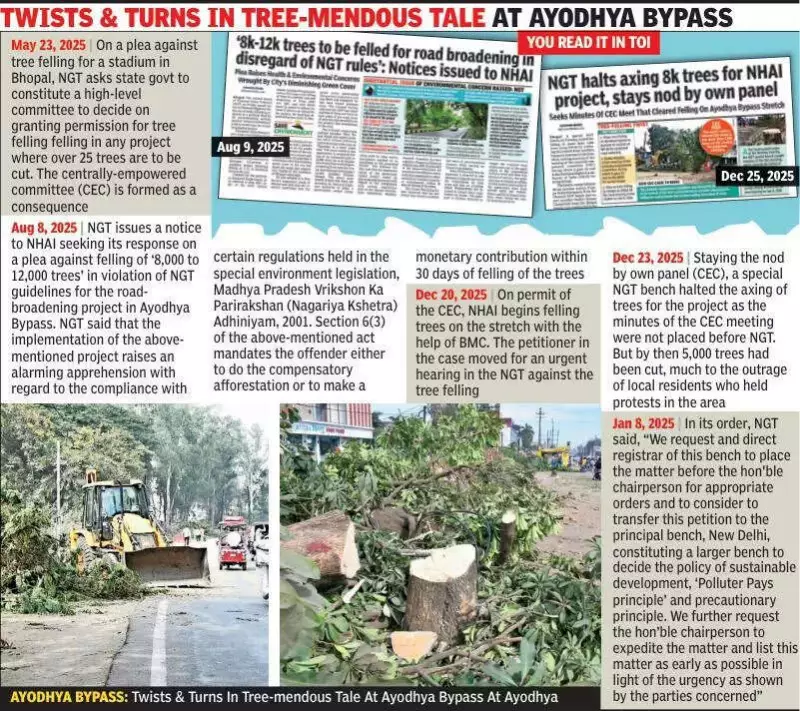
The central bench of the National Green Tribunal (NGT) has taken a significant step towards formulating a nationwide policy for large-scale tree felling in development projects. This move comes in response to the controversial case involving the cutting of over 8,700 trees for a road-widening project in Bhopal.
Case Referred to Principal Bench in Delhi
The NGT's central bench, comprising judicial member Sheo Kumar Singh and expert member Sudhir Kumar Chaturvedi, has referred the matter to a larger principal bench in New Delhi. The case revolves around the permission granted to the National Highways Authority of India (NHAI) to cut trees on a 16-kilometer stretch from Ayodhya Bypass to Asaram Tri-section for road broadening.
The tribunal, in its order on Thursday, raised serious questions about the rationale and legality of the permit granted for this mass felling. The permission was given by a centrally-empowered committee (CEC) constituted by the Madhya Pradesh government in the third week of December, following directives from the NGT central bench itself.

Swift Action and Public Outrage
After receiving the permit, NHAI, with assistance from the Bhopal Municipal Corporation (BMC), began cutting trees at the site. However, Harpreet Singh Gupta, counsel for the petitioner Nitin Saxena, swiftly moved an application for an urgent hearing before the NGT.
The green tribunal later issued a stay order on the cutting, but by that time, an estimated 5,000 trees had already been felled. This rapid action sparked significant outrage among local residents, who held protests in the area, a fact noted by the NGT bench in its proceedings.
NGT Bench Acknowledges Public Sentiment
The NGT order explicitly acknowledged the public distress. It stated, "Cutting of trees to the extent of more than 8,000 to 12,000 for a 16-kilometer 10-lane road project... within the city and around is a matter of discussion and pains the locals." The bench further observed that media coverage highlighted how the civil society is keen to preserve these trees, which act as the lungs for the city of Bhopal.
The tribunal also referenced a previous high-level committee it had constituted. This committee's mandate was reinforced by the Madhya Pradesh High Court's Jabalpur bench, which had directed that no trees be cut in the state without prior permission from the NGT-formed committee and the concerned Tree Officer.
Clash of Development and Conservation
During the hearing, the counsel for NHAI emphasized the principles of sustainable and economic development, underscoring the need for highways and the urgency to expedite the project. In contrast, the petitioner's counsel highlighted the critical need to conserve the existing green cover for the well-being of Bhopal's residents.
Weighing these arguments, the NGT bench concluded that the issue requires thorough consideration at a pan-India level. It expressed the view that a comprehensive policy must be framed, considering the opinions of the high-level committee and relevant judicial precedents from the Supreme Court and High Courts regarding tree felling for economic development.
Consequently, the bench has directed the registrar to place the matter before the NGT chairperson. The goal is to transfer the petition to the principal bench in New Delhi and constitute a larger bench. This larger bench would be tasked with deciding on a policy framework that balances sustainable development, the 'Polluter Pays' principle, and the precautionary principle. The tribunal has also requested the chairperson to expedite the hearing due to the urgency demonstrated by all parties involved.