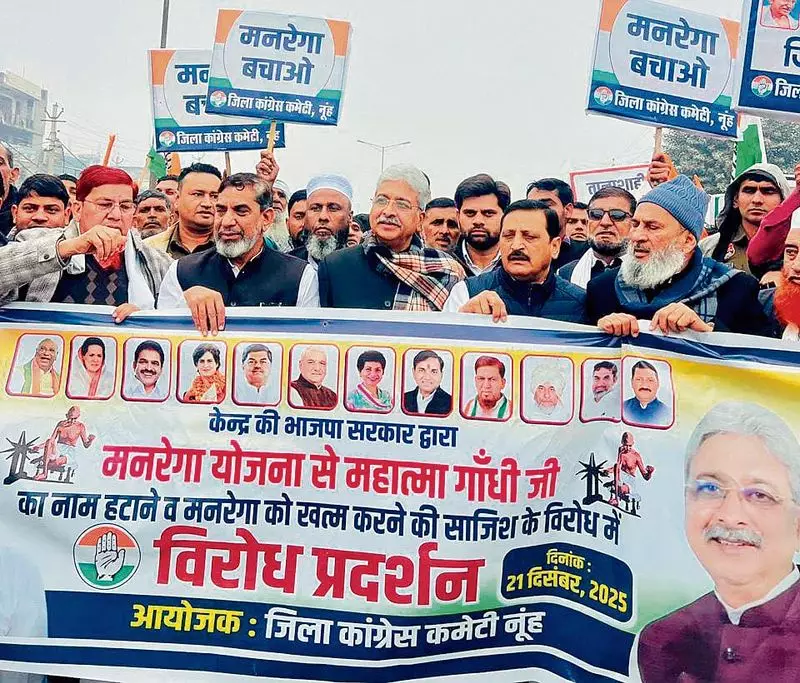
Former Haryana minister and senior political leader Narender Singh has launched a sharp critique against the central government's recent overhaul of the Mahatma Gandhi National Rural Employment Guarantee Act (MGNREGA) scheme. He has termed the move, executed without a parliamentary discussion, as a direct insult to India's democratic processes.
A Major Policy Shift Without Parliamentary Scrutiny
Singh's criticism centres on the significant changes made to the flagship rural employment guarantee programme. He emphasised that MGNREGA is not just any scheme but a crucial lifeline for millions of India's rural poor, guaranteeing them work and wages. Implementing a major overhaul of such a critical social security net without bringing it before Parliament for a thorough debate is fundamentally undemocratic, he argued.
The leader pointed out that Parliament is the supreme forum for discussing matters of national importance, especially those impacting the most vulnerable sections of society. By bypassing this essential legislative scrutiny, the government has undermined the institution's role and disregarded the principles of transparency and accountability.

Questioning the Intent and Impact on Rural Poor
Narender Singh raised serious concerns about the potential impact of these changes on the ground. MGNREGA has been instrumental in providing economic security and boosting rural demand. Any structural modification to its framework could have far-reaching consequences for the livelihood of crores of people dependent on it.
The lack of an open debate prevents stakeholders, opposition parties, and civil society from examining the proposed changes, questioning their intent, and suggesting improvements. Singh implied that this approach suggests the government might be attempting to dilute the scheme's effectiveness or alter its core pro-poor objectives away from public oversight.
A Call for Democratic Accountability
In his statement, Singh made a firm demand for the central government to immediately initiate a detailed discussion on the MGNREGA revisions in Parliament. He stressed that the people's elected representatives must have the opportunity to debate the merits and drawbacks of the policy shift.
This episode highlights a growing tension between executive action and legislative oversight in India's policy-making landscape. Singh's remarks frame the issue not merely as a political disagreement but as a vital concern for democratic health. The controversy puts the spotlight back on the Modi government's approach to implementing key policy changes and its engagement with parliamentary procedures.
The former minister's strong condemnation is likely to resonate with opposition parties and activists who have consistently raised alarms about the centralisation of power and the marginalisation of parliamentary debate on critical issues. The future of MGNREGA, and the manner in which it is governed, remains a contentious point in India's socio-political discourse.