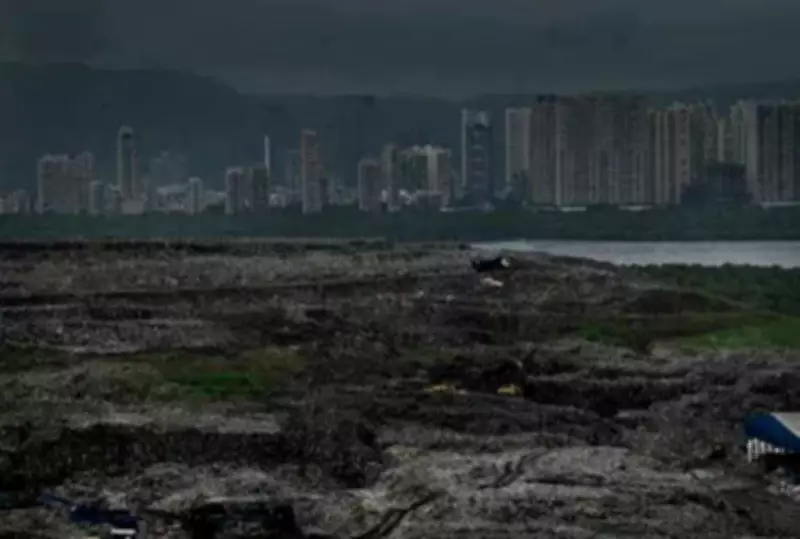
The Bombay High Court on Monday directed the Brihanmumbai Municipal Corporation (BMC) to conduct scientific monitoring of odour emanating from the Kanjurmarg landfill treatment facility between 1 am and 6 am, and to map the distance it travels. The court also instructed the Maharashtra Pollution Control Board (MPCB) to monitor emissions from nearby industries, maintain records, and display them publicly to aid in formulating an action plan.
BMC Appoints Expert Committee
In an affidavit submitted to the court, the BMC, through its senior counsel Anil Sakhare, informed that it has constituted an expert committee comprising specialists from IIT Bombay and NEERI. The committee will study a recent report indicating high methane levels at the Kanjurmarg dumping ground and advise on mitigation measures.
Court's Concerns After Site Visit
The division bench of Justices Girish Kulkarni and Aarti Sathe, who conducted a surprise inspection of the Kanjurmarg site on April 25, emphasized that their primary concern is ensuring that methane, a natural byproduct of landfills, does not harm thousands of nearby residents. They stressed the need to capture methane for productive use rather than allowing it to contribute to global warming.

Justice Kulkarni noted that methane is odourless but extremely dangerous and a significant cause of global warming. He acknowledged that the BMC is already tapping methane to generate electricity at the site. The judges described their visit as a learning experience and appreciated the explanations provided by civic officials and the contractor. They also directed the BMC to take MPCB counsel R V Govilkar to the site on Friday.
Petitions Highlight Pollution and Mangrove Protection
The court was hearing two petitions: a public interest litigation (PIL) filed in 2009 by NGO Vanashakti, represented by its director D Stalin, and a petition by Kannamwar Nagar Cooperative Housing Society. Both petitions raised concerns about pollution from the Kanjurmarg landfill and the need to protect mangroves in the area.
Justice Kulkarni observed during the visit that the mangroves on one side of the highway were lush green and attracted migratory birds, including flamingos, affirming the petitioners' claims about the ecological importance of the area. He stressed that both the greenery and the birds require protection.
Odour Issue and Resident Impact
The bench expressed dissatisfaction with the BMC's affidavit, which it said was silent on the odour issue raised by the PIL petitioner. The court also criticized the contractor's odour mitigation efforts. Vanashakti's counsel Zaman Ali highlighted that the odour is particularly strong between 1 am and 6 am. The court asked how many families are affected, and the Kannamwar Nagar society's counsel Kulkarni and advocate Abhijeet Rane stated that the area has a population of 15 lakh residents.
Mitigation Steps and Court's Warning
The judges appreciated the explanations provided by senior civic officials regarding waste treatment and mitigation at the BMC's Integrated Waste Management Facility. Saket Mone, representing contractor Antony Lara Enviro Solutions Pvt, said methane is captured for a biomethanation project to produce biogas.
Senior counsel Sakhare stated that the BMC plans to undertake mitigation steps to protect citizens from health hazards and will begin tree plantation at the site. Justice Kulkarni advised them to ensure the plantation is realistic.
Additional Municipal Commissioner Bipin Sharma and Deputy Municipal Commissioner Kiran Dighavkar were present in court.
The court directed the BMC to remove three paragraphs from its affidavit that were described as adversarial, which questioned the petitioner's reliance on a news report about high methane levels.
The bench warned that if the ill-effects of emissions are not adequately addressed and corrective measures are not taken, the court may have no alternative but to restrict or stop activities at the site, considering the paramount importance of human life under Article 21 of the Constitution. The court cautioned both municipal and state authorities about the seriousness of the situation and suggested they begin identifying an alternative site for dumping operations to avoid adverse effects on human habitation.