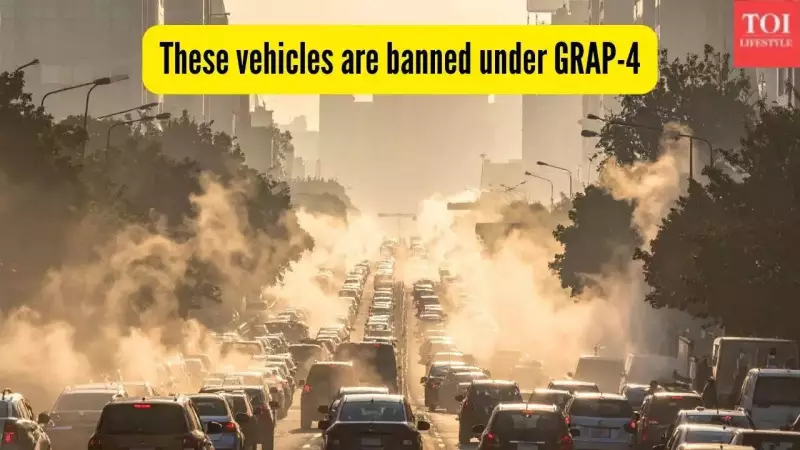
Delhi and the National Capital Region (NCR) have plunged into a severe air pollution crisis, prompting authorities to activate the most stringent level of emergency measures. In response to the hazardous air quality, the government has now enforced Stage 4 of the Graded Response Action Plan (GRAP-4), bringing with it sweeping restrictions on road traffic and heavy penalties for violators.
What is GRAP-4 and Why is it Activated?
The Graded Response Action Plan (GRAP) is a series of pre-defined emergency steps designed to tackle worsening air pollution in Delhi-NCR. GRAP-4 represents the highest and most severe stage of this plan. It is triggered when the Air Quality Index (AQI) surpasses 450, entering the 'Severe Plus' category. The statutory body responsible for implementing these rules is the Commission for Air Quality Management (CAQM), established under the CAQM Act of 2021.
Which Vehicles Are Banned and Which Are Allowed?
The primary focus of GRAP-4 is to curb emissions from older, more polluting vehicles. The immediate ban applies to several categories.

Vehicles that are now prohibited from plying on Delhi roads include:
- All BS-III compliant petrol vehicles.
- All BS-IV compliant diesel vehicles.
- Non-BS-VI vehicles entering Delhi from other states.
- Older diesel-powered commercial vehicles (BS-IV standard or below), with an exception only for those involved in essential services.
Vehicles permitted to operate during this period are:
- BS-VI compliant petrol and diesel vehicles.
- All Electric Vehicles (EVs).
- Vehicles running on Compressed Natural Gas (CNG) and Liquefied Natural Gas (LNG).
- Emergency and essential services vehicles.
- Public transport vehicles that meet current emission norms.
- Any vehicle with a valid registration and a current Pollution Under Control (PUC) certificate.
Hefty Fines and Strict Enforcement on Ground
Authorities have warned of severe consequences for those defying the GRAP-4 restrictions. The penalty for driving a banned BS-III petrol or BS-IV diesel vehicle is up to ₹20,000. Additionally, a fine of up to ₹10,000 can be levied for not possessing a valid PUC certificate. In serious cases, violating vehicles can also be impounded by the traffic police.
To ensure compliance, a multi-pronged enforcement strategy has been deployed across the capital. Traffic police have set up checkpoints at major roads and entry points. There is increased monitoring at fuel stations and through on-ground inspections. The authorities are also utilizing Automatic Number Plate Recognition (ANPR) cameras to identify violators automatically. Officials have stated that these strict measures will remain in force until a significant improvement in air quality is observed.
Residents of Delhi-NCR are being strongly advised to minimize personal vehicle use and opt for public transport or carpooling to help reduce the collective emission load and navigate through this public health emergency.