The Delhi government is crafting a new policy to expedite long-delayed development projects by simplifying the process of removing Vilayati Kikar, an invasive tree species that has obstructed numerous infrastructure plans. The initiative seeks to strike a crucial balance between pressing ecological concerns and the execution of pending public works.
New SOP to Bypass Regulatory Hurdles
Officials stated that the forest department has been directed to identify all sites where Vilayati Kikar and similar invasive species are blocking planned infrastructure and utility projects. The core of the new policy involves removing this species from the list of trees that require prior permission from a tree officer for felling. Instead, a comprehensive Standard Operating Procedure (SOP) is being formulated to govern its removal.
This is not the government's first attempt to tackle the issue. The initial proposal to remove the invasive species was launched in 2017, targeting 10 hectares in the Central Ridge. While the cabinet cleared the plan in 2022, it stalled due to procedural roadblocks. An expert advisory committee, formed in March 2021 to monitor the "Ecological Restoration of Central Ridge" project, saw repeated deferments as members held differing views on the removal's extent, impact, and methodology.

Balancing Act: Removal and Restoration
The government emphasizes that the new approach will be limited and need-based, avoiding large-scale clearance. The invasive trees will be removed using canopy lifting, a technique designed to minimize damage to surrounding soil and vegetation. Crucially, replacement planting will be mandatory.
Cleared areas will be restored with indigenous trees, shrubs, and grasses following biodiversity enrichment norms, ensuring ecological restoration accompanies development. Officials assured that the forthcoming SOP will include strict checks, approvals, and monitoring to prevent misuse, addressing concerns from environmental groups that eased permissions could lead to the felling of other native species under false pretenses.
Unblocking Key Projects
One major project awaiting this policy shift is the development of a sports university on 79 acres in Ghevra village, stuck for years. A tree survey found that of nearly 9,000 trees on the plot, 3,212 need to be chopped down and 88 transplanted. A significant majority of these are Vilayati Kikar.
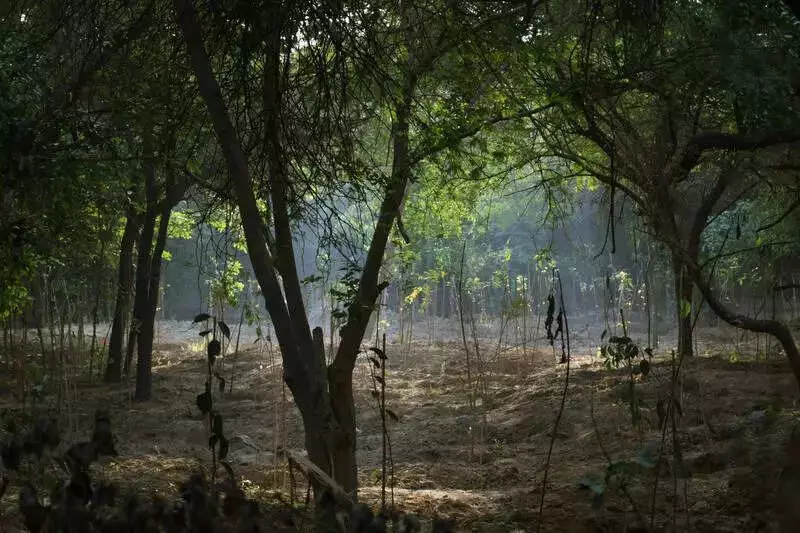
Native to South and Central America, Vilayati Kikar has dominated Delhi's landscapes for nearly a century. It is a fast-growing tree with a dense canopy that blocks sunlight, spreads aggressively, and displaces native plants. Experts note its shallow spreading roots and deep taproots rapidly absorb rainwater and groundwater, lowering the local water table. It also exhibits allelopathic properties, releasing chemicals that stunt the growth of nearby plants, leading to biodiversity loss.
With the renewed push, the forest department is preparing a fresh proposal for re-approval, incorporating clearer safeguards and site-specific criteria to finally move these critical projects forward while healing the ecosystem.