Delhi's borders transformed into scenes of confusion and long queues on Thursday morning as a stringent pollution control measure came into force. The implementation of the Graded Response Action Plan (GRAP) Stage IV rule, which prohibits the entry of vehicles not registered in Delhi and not compliant with BS 6 emission norms, led to massive traffic disruptions during peak hours.
Peak Hour Gridlock and Widespread Checks
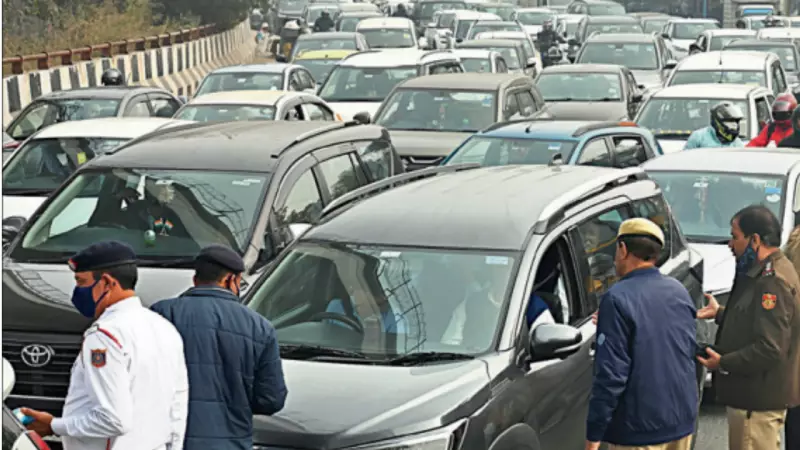
The sudden enforcement caught thousands of daily commuters off guard. At routine entry points, police swiftly set up checkposts, stopping vehicles bumper-to-bumper. The air was filled with the sound of whistles and the frequent question from officials: "BS 6?" They meticulously scanned registration certificates and recorded details in handwritten registers, causing traffic to slow to a crawl.
Drivers found themselves stuck in idling cars, inching forward in serpentine lines, uncertain if they would be allowed to proceed or ordered to turn back. The situation was particularly severe at key borders connecting Delhi with its satellite cities in the National Capital Region (NCR).

By the Numbers: A Day of Enforcement
Official data from the day's enforcement paints a clear picture of the scale. Across 13 major border points from Kapashera to Badarpur, traffic police checked a total of 2,768 vehicles for BS 6 compliance till 4 pm. Out of these, 460 vehicles were denied entry and forced to turn back.
The highest number of rejections occurred at the Najafgarh border, where 175 vehicles were sent back. This was followed by the Sarita Vihar and Kalindi Kunj borders, which together turned away 93 vehicles, and the Badarpur border, which sent back 33. In contrast, enforcement was lighter at borders like Narela (9 vehicles turned back) and Kapashera (8).
At the busy Noida-Kalindi Kunj border alone, around 30 cars were made to U-turn between 9:30 am and 10:30 am. Each reversal created fresh snarls just meters from the barricades, compounding congestion on already clogged stretches.
Commuters' Plight: From Unawareness to Anger
The rapid rollout of the rule, announced just on Tuesday, left many citizens frustrated and inconvenienced. Numerous commuters reported having no prior warning. Dipak, who set out early from Greater Noida's Pari Chowk with his wife for a religious visit to Khatu Shyam, was stopped at Kalindi Kunj. "We genuinely didn't know about the rule," he said. "Google Maps showed this route, so we came. Now we have to go back 27km and start all over again."
Similar stories unfolded across borders. Brigadier Chawla, travelling with his daughter from the US to Haryana, was stopped. Advocate Vijay Mittal, heading to court, was aware of the order but didn't realise his diesel BS IV car would be barred. In a particularly distressing case, a person taking his father for dialysis treatment had to be turned back.
Many displayed confusion over emission categories. When Poonam's car was stopped at Mayur Vihar's Chilla border, she argued, "Arey, it's a petrol car." Upon learning it wasn't BS VI compliant, she asked, "Sorry, what does that mean?" before finally taking a U-turn.
Commuters like Anil Kumar, a real estate professional, questioned the communication strategy. "There are people who don't follow the news regularly. How are they supposed to know?" he asked, suggesting automated SMS or WhatsApp alerts from the transport department.
Logistical Challenges and Expert Criticism
The enforcement exposed a significant gap between policy intent and on-ground manpower. Traffic police admitted it was challenging to simultaneously stop vehicles, check documents, and manage traffic flow. Over 500 traffic police personnel and 37 Prakhar vans were deployed across major borders and internal stretches.
However, these numbers were often dwarfed by the volume of vehicles. At Kalindi Kunj, only about 11 personnel managed a peak-hour flow that can reach nearly 200,000 vehicles. At Mayur Vihar, just 7-9 officers were on duty.

Transport expert Anil Chhikara criticised the move as "premature" and warned that such border checks could be counterproductive. "Turning vehicles back at borders only leads to idling and higher emissions," he said. "Pollution in the NCR is a regional problem and treating it as only a Delhi issue won't help." He also pointed out that enforcement would inevitably be compromised due to poor manpower.
The situation eased somewhat after the morning peak hours as traffic volumes fell, but checks continued into the evening. The day's events highlighted the complex challenges of implementing sweeping environmental directives in a densely populated metropolitan region, balancing urgent pollution control with the daily mobility needs of millions.