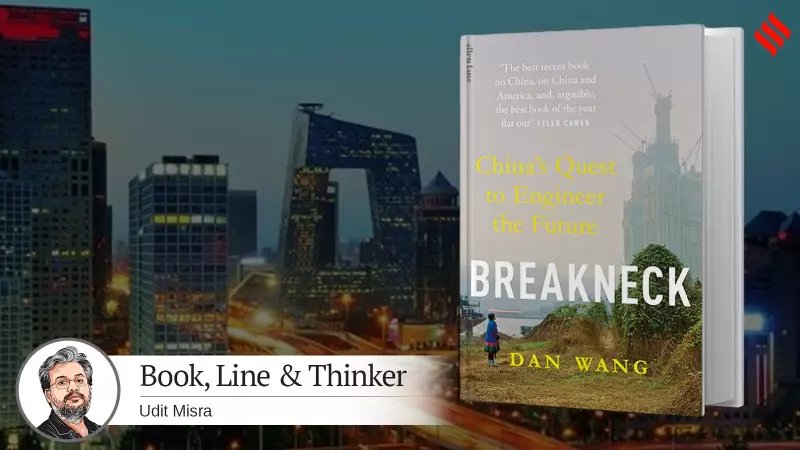
At first glance, Dan Wang's new book 'Breakneck: China's Quest to Engineer the Future' appears to be another analysis of China's global ambitions by a Chinese author. However, readers would be surprised to discover that Wang is actually a Canadian technology analyst who left China with his parents when he was just seven years old.
Currently serving as a research fellow at the Hoover History Lab of Stanford University, Wang brings unique perspective having closely tracked China's development while working in Hong Kong, Beijing, and Shanghai. His book serves less as an examination of China's quest and more as a direct letter to American citizens and policymakers about what the United States can learn from China's approach to maintain its global supremacy.
The Core Conflict: Construction Versus Obstruction
Wang identifies the fundamental difference between the two superpowers as what he calls 'the competition that will define the twenty-first century'. He contrasts America's elite, dominated by lawyers who excel at obstruction, against China's technocratic class, composed mainly of engineers who excel at construction.

This engineering-driven approach has enabled China to build at what Wang describes as 'breakneck speed,' while the United States struggles under the weight of inefficient processes and inadequate public infrastructure. The implications are stark: China focuses on building and taking over the world, while America remains preoccupied with arguments and procedures.
Staggering Infrastructure Achievements
The book presents compelling evidence of China's construction prowess. Since 1980, China has accomplished remarkable feats including building a highway network twice the size of the US system, creating a high-speed rail network twenty times more extensive than Japan's, and developing almost as much solar and wind capacity as the rest of the world combined.
Wang notes that China's manufacturing dominance is so complete that a rough rule of thumb suggests the country produces one-third to one-half of nearly any manufactured product on the planet. This rapid growth over the past 45 years contrasts sharply with America's steady decline in manufacturing capability and deteriorating public infrastructure.
The Tale of Two Rail Projects
Wang provides a striking example that highlights the execution gap between the two nations. In 2008, both California voters approved a high-speed rail link between San Francisco and Los Angeles, and China began construction on a similar-distance line between Beijing and Shanghai.
The results couldn't be more different. China completed its 800-mile line in 2011 at a cost of $36 billion, and in its first decade of operation, the route completed 1.35 billion passenger trips. Meanwhile, California's project remains incomplete with latest cost estimates ballooning to $128 billion and the first segment not expected to operate until between 2030 and 2033.
Leadership Composition: Engineers Versus Lawyers
The book delves into the fundamental reason behind this disparity: the professional backgrounds of each country's leadership. Wang notes that China's leadership is overwhelmingly dominated by engineers, a trend initiated by Deng Xiaoping in the 1980s and 90s. By 2002, all nine members of the Politburo's standing committee were engineers, and President Xi Jinping, a chemical engineer himself, has reinforced this trend.
In contrast, American leadership is dominated by lawyers. From 1984 to 2020, every single Democratic presidential and vice-presidential nominee attended law school, with lawyers also forming the Republican elite. Only two American presidents—Herbert Hoover and Jimmy Carter—have been engineers by training.
While Wang acknowledges the downsides of China's engineering-focused approach, including the one-child policy and zero-Covid measures that applied engineering principles to society with disastrous results, he emphasizes that these are not the lessons America should adopt. Instead, he suggests the US could reignite its enthusiasm for building and move beyond its obsession with procedures and belief that government is inherently problematic.

For Indian readers, the book offers valuable insights about balancing regulatory frameworks with development needs. Wang's central argument that informed mutual curiosity between superpowers serves as the best hedge against heightening tensions provides a framework that could benefit India's own strategic positioning in global affairs.