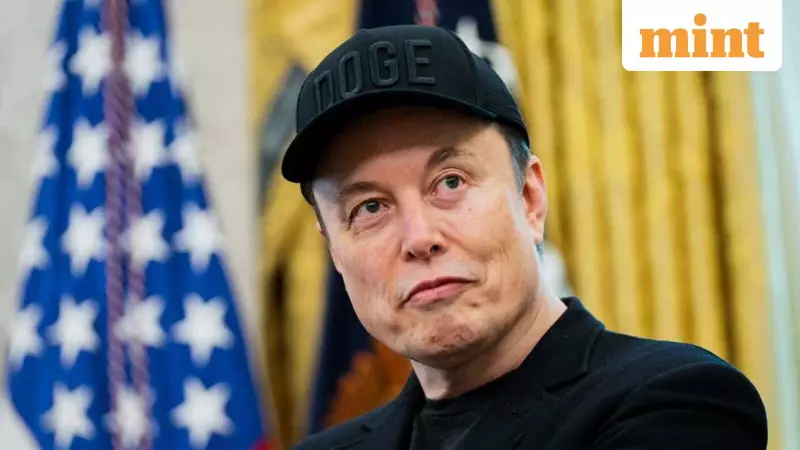
In a world increasingly dominated by digital platforms, the lines between technology corporations and state authority are blurring at an alarming rate. A series of recent events and analyses suggest that a new class of tech 'broligarchs'—a blend of 'tech bros' and 'oligarchs'—is amassing unprecedented political power, shaping policies, elections, and public discourse.
The Death of Letters and the Rise of Digital Overlords
The symbolic end of an era was marked when Denmark's postal service announced it would stop carrying letters by the end of December 2025. This move, from the land of Hamlet, signals the extinction of one of humanity's oldest communication forms. Concurrently, December has become a month of stark warnings about the barons of the digital age. Nobel laureate economist Paul Krugman recently branded the US a "digital narco-state," while Financial Times columnist Edward Luce coined the term "broligarchs" to describe tech magnates with an alarmingly pessimistic and authoritarian worldview.
Luce argues that the US government now acts as "lawyer, promoter, hit man and agent" for firms like Meta, Palantir, and X. "Trumpian populism may be the story of our age," he writes, "but I am increasingly persuaded that we are underplaying the tech-authoritarian elephant in the room."

Musk, Karp, and the Direct Assault on Democratic Processes
Perhaps no tycoon exemplifies this political meddling more overtly than Elon Musk. His political involvement provides a potent case for campaign finance reform. He made a roughly $250 million donation to Donald Trump's 2024 presidential campaign and even offered $100 to voters attending Trump rallies in the battleground state of Pennsylvania. Not content with influencing US politics, Musk has now set his sights on the UK.
Using his platform X, Musk has supported figures like Tommy Robinson, a far-right activist released from jail in 2025. Robinson helped organize a major anti-immigrant rally in London in September 2025, where Musk appeared via video link. Musk declared, "Whether you choose violence or not, violence is coming to you. You either fight back or you die." Despite Labour's landslide victory for a five-year term in 2024, Musk called for a dissolution of Parliament and a new vote, with many of his statements bordering on hate speech.
Similarly, Palantir founder Alex Karp has displayed an authoritarian mindset. Critics allege that Karp, along with Peter Thiel and Musk, use their influence to exaggerate the ill effects of immigration while favoring policies that benefit Caucasians. Palantir's software is actively used by the US government to track illegal immigrants.
The Institutional Capture: When Tech Executives Become Commanders
The fusion of corporate and state power is not merely rhetorical; it is institutional. A report highlighted by a University of academic details a profound capture of the US government. This includes a ten-billion-dollar contract with Palantir Technologies framed as a quest for 'efficiency.' The Federal chief information officer is a former decade-long Palantir employee. Furthermore, Peter Thiel's former chief of staff now heads the White House's science and technology policy.
In a startling development, Silicon Valley executives from Meta, Palantir, and OpenAI transitioned to become lieutenant colonels in the US army in June 2025. As the report observes, "The line between contractor and commander has been erased." This institutional blurring extends to foreign policy, with the US administration attacking European democratic values, partly driven by a broligarch agenda that frames EU data protection laws as a conspiracy against US tech firms.
The Global Response and Our Shrinking Attention
While some nations are pushing back—Australia began implementing a social media ban for children under 16 this month—a cohesive global response is lacking. The EU remains the most likely actor to regulate, but US-EU trade talks risk being derailed by disagreements over Big Tech's economic stranglehold.

Beyond politics, the very fabric of human cognition is being altered. In his book *The Shallows*, Nicholas Carr explores how screens inflict a universal attention deficit. A pathologist from the University of Michigan medical school confesses, "I can't read War and Peace anymore." This resonates with a personal struggle to engage with deep reading, constantly disrupted by YouTube or WhatsApp, leading even the most resolute back to the digital shallows—perhaps to watch *War and Peace* on BBC iPlayer instead of reading it.
The convergence of shrinking attention spans and the growing political power of unelected tech magnates presents a fundamental challenge to democratic governance. As platforms algorithmically shape what we read, think, and vote on, the need for legal frameworks to police hate speech and anti-democratic manipulation has never been more urgent. The capture of state authority by Big Tech is no longer a dystopian fantasy; it is the unfolding reality of our digital age.