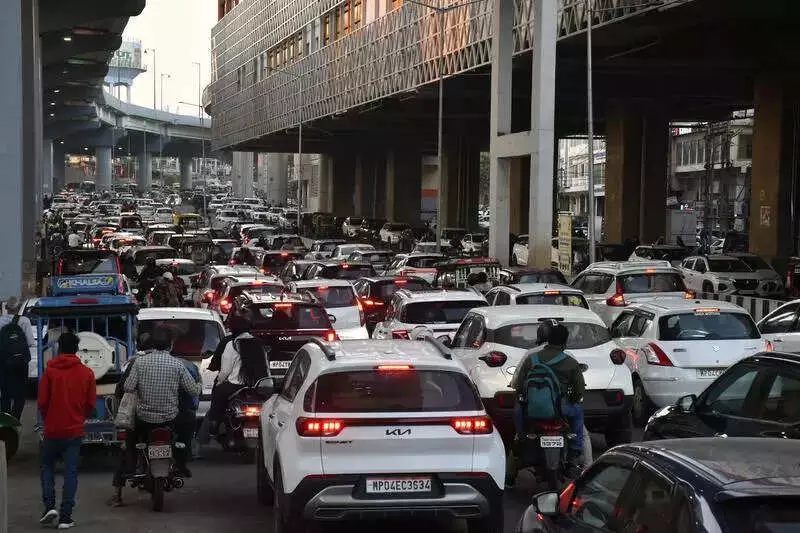
After years of delays and anticipation, the Bhopal Metro has finally rolled out its services, marking a significant milestone for the city's public transport. However, for countless daily commuters, the dream of faster, smoother travel remains stuck in traffic. A week into its launch, the new metro service has yet to make a visible impact on the city's notorious congestion, with key intersections like Board Office Square, MP Nagar, and DB Mall remaining as choked with vehicles as ever during peak hours.
The Last-Mile Hurdle: A Broken Promise
The core issue crippling the Metro's potential is the absence of a reliable feeder network. The envisioned seamless integration with buses, e-rickshaws, and e-bikes has failed to materialize. On the ground, e-bikes lie unused, bus services are parked indefinitely, and e-rickshaws continue to negotiate bans on main routes. This critical gap leaves passengers stranded at stations, undermining the time saved by the metro itself.
"I took the metro to work today—it's comfortable, clean, and fast," shared Ritesh Verma, a bank employee commuting from Berkheda Pathani to MP Nagar. "The real issue is reaching the station. Without better connectivity, it doesn't save me much time." His sentiment echoes a widespread challenge facing urban planners across India: making public transit door-to-door convenient to wean people off private vehicles.

Official Acknowledgment and Long-Term Vision
State officials concede that the metro's effect on traffic will be limited in these initial stages. Construction on subsequent phases is ongoing across key routes, with barricades and narrowed lanes ironically adding to the current gridlock in some areas. A senior official admitted that until the full corridor becomes operational, the impact on road traffic will remain partial.
An unnamed senior state government official emphasized that large-scale infrastructure projects require time. "Bhopal Metro is a long-term investment in sustainable urban transport," he stated. "As more corridors open, the city will experience reduced congestion and cleaner air."
Glimmers of Hope Amidst Growing Pains
Despite the teething troubles, early riders have praised the metro's modern amenities, cleanliness, and comfort. This positive reception forms a foundation for future growth. Many believe that once the feeder transport ecosystem and fare systems stabilize, ridership will increase significantly.
"Once last-mile connectivity improves, I think people will start leaving their cars at home," expressed a hopeful commuter. For now, Bhopal presents a tale of two realities: above, the sleek metro glides silently as a symbol of progress, while below, the city's roads remain clogged and chaotic. The metro's early journey mirrors the complex growing pains of urban transformation, where success hinges not just on trains and tracks, but on their seamless integration into the city's daily rhythm.