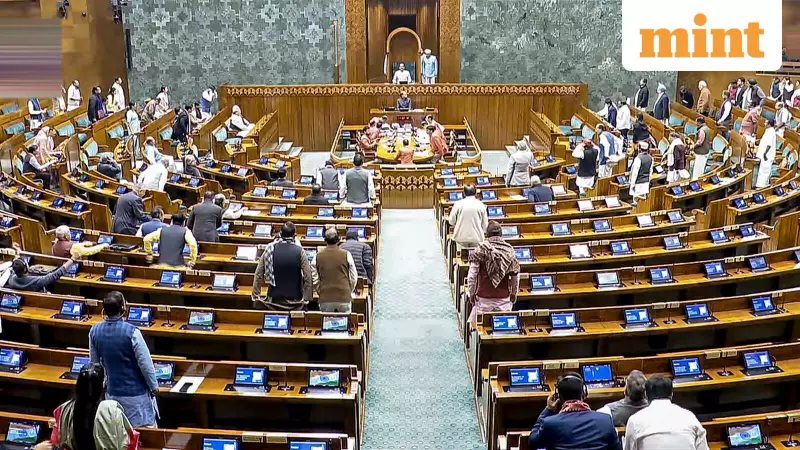
The Lok Sabha was adjourned sine die on Friday, marking the conclusion of a 19-day Winter Session that was characterized by the passage of significant legislation, intense political clashes, and unresolved opposition demands for a deeper examination of electoral processes. The session, which commenced on December 1, wrapped up after 15 sittings.
Session Concludes with High Productivity
As the House assembled for its final day, Speaker Om Birla delivered a valedictory address. He highlighted that the Lok Sabha recorded an unusually high productivity of 111 percent during this session, with members frequently extending discussions late into the night to deliberate on crucial bills. Following his address, where some members chanted "Mahatma Gandhi ki jai," Birla adjourned the House sine die, formally ending the session. Prime Minister Narendra Modi was present in the House during the adjournment.
Flagship Legislation Takes Center Stage
The Winter Session was dominated by the passage of several high-impact Bills with wide-ranging political and economic implications.

The most contentious was the Viksit Bharat Guarantee for Rozgar and Ajeevika Mission (Gramin) Bill, 2025 (VB-G RAM G Bill). This legislation replaces the two-decade-old MNREGA framework and promises 125 days of guaranteed employment in rural India. Its passage was met with strong opposition protests, including the tearing of papers in the House.
Another landmark law passed was the Sustainable Harnessing and Advancement of Nuclear Energy for Transforming India (SHANTI) Bill. This Bill opens India's tightly controlled civil nuclear energy sector to private participation, marking a major policy shift.
In a significant economic reform, Parliament cleared the Sabka Bima Sabki Raksha (Amendment of Insurance Laws) Bill, 2025 to raise the foreign direct investment (FDI) limit in the insurance sector from 74 percent to 100 percent. The Rajya Sabha passed this Bill via a voice vote.
Other Legislative Business and Political Flashpoints
Beyond the flagship reforms, Parliament also passed a Bill to repeal 65 obsolete Amendment Acts and six principal laws. A proposed law to create a new higher education regulator, the Viksit Bharat Shiksha Adhisthan Bill, 2025, was sent to a joint parliamentary committee for review. Additionally, the Securities Markets Code Bill was introduced and referred to a standing committee for scrutiny.
The session was politically charged, with debates on the 150th anniversary of "Vande Matram" and on election reforms. The latter became a major flashpoint as opposition parties demanded a discussion on the Election Commission's Special Intensive Revision (SIR) of electoral rolls in 12 states and Union Territories. The government refused to debate the Election Commission's functioning, allowing only a broader discussion on reforms. The opposition accused the government of "vote chori" (vote theft) and criticized the new law for appointing election commissioners.
A scheduled debate on air pollution, which was to be initiated by Congress leader Priyanka Gandhi, did not take place.
Implications and the Road Ahead
The Winter Session demonstrated the Narendra Modi-led government's ability to drive an ambitious legislative agenda across sectors like employment, energy, and finance. However, it also starkly revealed the deep and persistent political divisions within Parliament, particularly concerning issues of electoral integrity and the independence of key institutions like the Election Commission. The session sets the stage for continued political confrontation as the nation moves closer to the next electoral cycle.