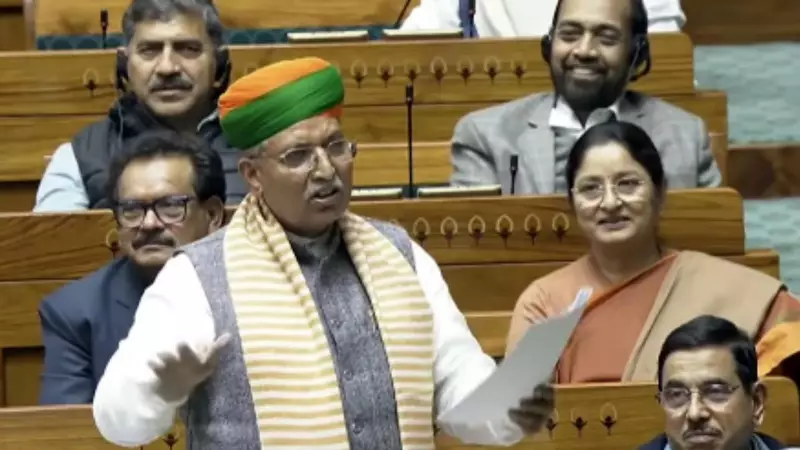
In a significant legislative move, the Lok Sabha on Tuesday approved a bill aimed at cleaning up the statute books by repealing dozens of laws deemed obsolete. The passage of The Repealing and Amending Bill, 2025 on the 12th day of Parliament's Winter Session has, however, sparked a political debate, with the government hailing it as a step against colonial legacies and the opposition accusing it of undue haste.
Government's Push for Legal Clean-Up
Introducing the bill, Union Minister for Law and Justice Arjun Ram Meghwal stated that its primary objective is to remove outdated and redundant laws from the legal system. He informed the House that since the Narendra Modi government came to power, 1,562 such Acts have been repealed and 15 amended. According to Meghwal, this ongoing exercise is intended to reverse the effects of colonisation embedded in old laws.
To illustrate the need for such repeals, the Minister cited an example of a discriminatory provision. "There was one law that if there was a will by a Hindu, Buddhist, Sikh, Jain or Parsi in Kolkata, Madras and Mumbai, it would have to be probated," he said, highlighting that other communities were exempt from this requirement.

What Does the Bill Actually Repeal and Amend?
An analysis by PRS Legislative Research clarifies the scope of the bill. The Statement of Objects and Reasons notes that the targeted Acts have either ceased to be in force, become obsolete, or their retention as separate statutes is unnecessary.
Out of the 71 Acts slated for repeal, 65 are Amendment Acts, whose changes have already been incorporated into the principal Acts they amended. Among the other notable laws being scrapped are:
- The Indian Tramways Act, 1886
- The Levy Sugar Price Equalisation Fund Act, 1976
- The Bharat Petroleum Corporation Limited (Determination of Conditions of Service of Employees) Act, 1988
The bill also proposes amendments to four existing Acts:
- The General Clauses Act, 1897 and The Code of Civil Procedure, 1908: To update terminologies related to registered posts.
- The Indian Succession Act, 1925: To remove the requirement for court validation of wills in certain cases.
- The Disaster Management Act, 2005: To rectify a drafting error.
Opposition Raises Concerns Over Haste and Intent
While BJP MP Manoj Tiwari supported the bill, arguing that outdated laws must be removed, opposition members voiced strong reservations. Their primary concern was the inclusion of laws passed recently.
Congress MP Dean Kuriakose questioned the rationale, asking, "They are also repealing laws passed 24 months ago. What kind of drama is this?" He specifically pointed to the amendment in the Disaster Management Act, which seeks to replace the word "prevention" with "preparation." Kuriakose expressed apprehension, stating, "What is the relevance? Are we signalling that the state is giving up on prevention? The government is diluting prevention."
Samajwadi Party's Lalji Verma echoed these concerns, criticising the government's legislative pace. "This government passes bills in a bullet-train-type hurry. They changed the name of the Mahatma Gandhi National Rural Employment Guarantee Act (MGNREGA). Many of these laws were brought in between 2016 and 2023. The minister should explain why they are outdated today," Verma said.
The passage of the bill marks another chapter in the government's drive to simplify the legal framework, but the opposition's questions ensure the debate over what constitutes an 'obsolete' law is far from settled.