Lok Sabha Proceedings Halted Repeatedly Over Contentious China Discussion
NEW DELHI: The Lok Sabha witnessed significant disruptions on Monday, leading to three adjournments before the proceedings were finally called off for the day. The turmoil erupted when Leader of the Opposition Rahul Gandhi insisted on raising the issue of the India-China confrontation of August 2020. His references were based on purported extracts from a yet-to-be-published book by former Army chief General M M Naravane.
Heated Exchanges Between Opposition and Treasury Benches
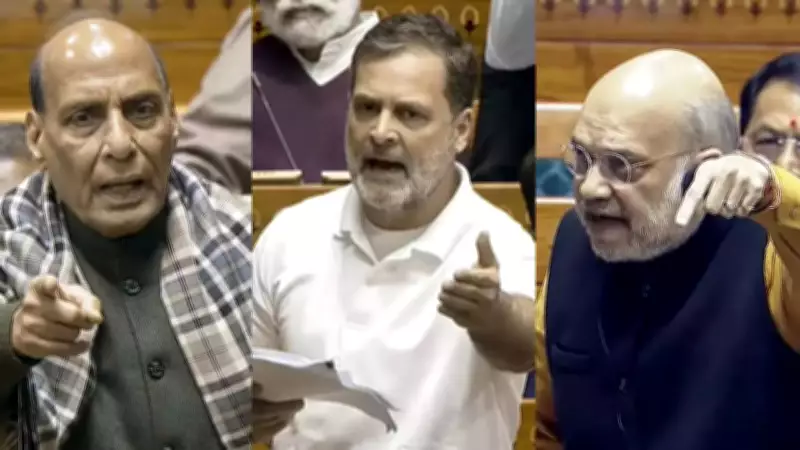
Defence Minister Rajnath Singh and later Home Minister Amit Shah repeatedly interrupted Gandhi, urging him not to quote from unverified sources. Gandhi was speaking during the motion for thanks to the President's address when the clashes began. Speaker Om Birla attempted to defuse the situation by issuing a ruling, asking Gandhi not to refer to news articles or extracts from unpublished books and to speak only on matters that could be authenticated by placing them on record.
However, the Leader of the Opposition maintained his stance, arguing that he should be allowed to speak on the issue. He pointed out that excerpts from the unpublished book had been published in Caravan magazine and were therefore authentic. Despite the Speaker's intervention, the clashes continued, leading to two adjournments before the chair ultimately adjourned the proceedings for the day.

Background of the Ruckus and Political Accusations
The ruckus began shortly after BJP's Tejashwi Surya spoke, recalling how presidential addresses during the UPA regime referenced Left-wing violence and bomb blasts across the country, along with sinking economic growth. In response, Gandhi cited the unpublished book, where General Naravane, who served as Army chief from 2019 to 2022, reportedly gave accounts of closed-door discussions with authorities seeking permission to act against the advancing Chinese Army after the Galwan clash, which resulted in the deaths of 20 Indian soldiers.
Gandhi stated that he was forced to raise the issue after the BJP made references to Congress's functioning during the previous UPA regime. Parliamentary Affairs Minister Kiren Rijiju interrupted Gandhi each time he mentioned the clash with the Chinese Army, emphasizing that the chair's ruling was binding on all members and that the discussion should be confined to the motion of thanks to the President's address.
Accusations and Counter-Accusations Escalate
Rahul Gandhi defended his position, stating that it was legitimate for him to respond since the defence minister, home minister, and prime minister often raise questions about "our character." He argued that the article raised questions about the PM, HM, and defence minister, and he was not being allowed to speak. Later, he accused Prime Minister Narendra Modi of avoiding a decision in the face of Chinese aggression, suggesting that the Modi government fears General Naravane's book would reveal the "reality" to the public.
Congress MP KC Venugopal accused the Modi government of distorting parliamentary rules to stop Rahul Gandhi from raising a genuine issue. He cited Rule 349, which states that a member "shall not read any book, newspaper, or letter except in connection with the business of the House." Venugopal argued that national security is a central issue of the President's joint address, making it relevant to the House's business.
BJP's Strong Rebuttal and Further Controversy
BJP leaders launched a strident attack on Rahul Gandhi, accusing him of weaponizing national security to demoralize the armed forces in an attempt to embarrass the government. BJP's Ravi Shankar Prasad told reporters that Gandhi's conduct was shameful and had become a habit of demoralizing the armed forces. He emphasized that there are numerous videos of General Naravane highlighting how India stood up to China during the 2020 conflict, with not an inch of land lost.

Parliamentary Affairs Minister Kiren Rijiju alleged that Rahul was using the sensitive issue of national security as a weapon for political reasons. He warned against playing with national security by speaking the language of anti-India elements and accused Gandhi of defying the chair. Rijiju also referred to the loss of Indian territory to China during the 1962 war, demanding an apology from Rahul Gandhi and questioning if he considered himself above Parliament by not following rules.
After Lok Sabha was adjourned, Rahul Gandhi continued his attack on the government in comments to the media outside Parliament, keeping the controversy alive. The incident underscores the deep political divisions and the sensitive nature of national security discussions in India's parliamentary proceedings.