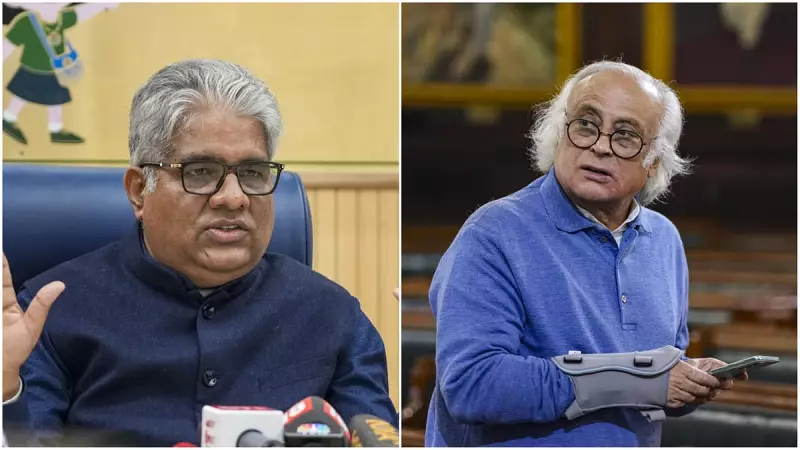
Union Minister Bhupender Yadav launched a sharp political attack on the Congress party, questioning its environmental credentials regarding the protection of the ecologically sensitive Aravalli hills. The minister's comments, made on 25 December 2025, highlighted a deepening political rift over conservation issues.
A Direct Challenge to Congress' Environmental Stance
In a pointed retort, Yadav dismissed the Congress party's position on the Aravallis, framing it as inconsistent. The minister directly challenged the opposition, stating, "We will not allow you to plunder." He further sharpened his critique by targeting the credibility of Congress' environmental advocacy.
"May be your 'environmentalist hat' would be credible if you questioned your party colleague Ashok Gehlot about who destroyed the Aravallis," Yadav stated. This remark explicitly links the current debate to the tenure of former Rajasthan Chief Minister Ashok Gehlot, a senior Congress leader, implying his administration's policies were detrimental to the mountain range.

The Core of the Political Clash
The exchange underscores the ongoing political battle where environmental governance is used as a tool for partisan criticism. Yadav's accusation suggests that the Congress' current stance is hypocritical, given the alleged actions of its own state government in the past. The Aravalli range, a critical geological feature and biodiversity hotspot spanning several states, has long been a flashpoint for debates between development and conservation.
By invoking Gehlot's name, the minister personalizes the attack and attempts to shift the focus onto the opposition's internal accountability. The statement, reported by Kalyan Ray, frames the ruling party as the true guardian of the environment against alleged past mismanagement.
Implications for Policy and Politics
This war of words has significant implications. Firstly, it raises the political stakes surrounding the protection of the Aravallis, making it a central issue for public debate. Secondly, it attempts to put the Congress party on the defensive, forcing it to reconcile its current advocacy with the environmental record of its previous state governments.
The confrontation signals that environmental policy, particularly concerning fragile ecosystems like the Aravallis, will remain a fiercely contested arena in Indian politics. The public exchange between a senior Union Minister and the principal opposition party sets the stage for further debates on land use, mining regulations, and sustainable development in ecologically vulnerable zones.