Lok Sabha Introduces Constitution Amendment Bill for Women's Reservation Implementation
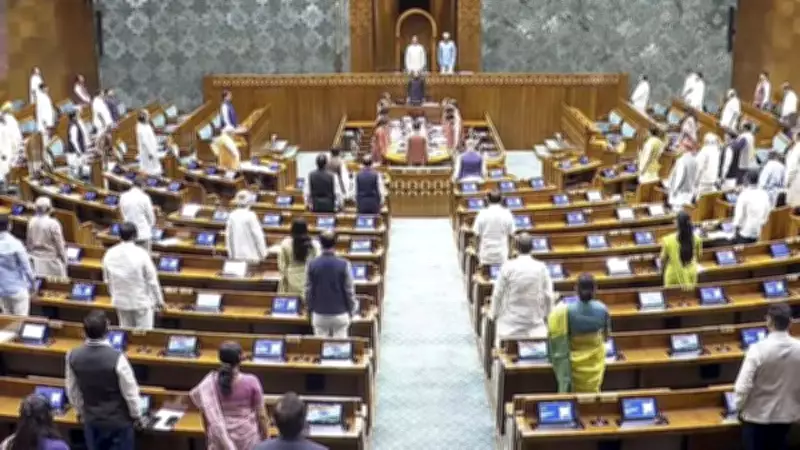
The Lok Sabha on Thursday witnessed a significant parliamentary development as it introduced the Constitution (131st Amendment) Bill, aimed at amending the women's reservation law. The introduction followed a division of votes, with 251 members supporting the move and 185 opposing it, marking a contentious start to the legislative process.
Three Bills Tabled Simultaneously for Comprehensive Framework
The government tabled three bills together to create a comprehensive framework for implementing women's reservation. Alongside the Constitution amendment bill, the Delimitation Bill and the Union Territories Laws (Amendment) Bill were introduced. These measures are specifically designed to operationalize the amended quota framework in Delhi, Puducherry, and Jammu and Kashmir, while simultaneously establishing the process for fresh delimitation exercises across the country.
The primary objective is to ensure women's reservation becomes functional before the 2029 general elections, addressing a long-standing demand for greater female representation in legislative bodies.

Heated Debate Over Delimitation Linkage
The bill's introduction followed a fiery 40-minute debate in the House, during which opposition parties strongly objected to the government's approach of linking women's reservation with delimitation and the proposed expansion of Lok Sabha seats. Several opposition leaders expressed concern that this linkage could delay or complicate the implementation of women's quota.
According to the draft bill circulated among members, the Lok Sabha's strength would increase significantly from the current 543 seats to a maximum of 850 after a delimitation exercise based on the 2011 Census. Similarly, seats in state assemblies and Union Territory legislatures would also be expanded to accommodate the 33 percent reservation for women.
Key Provisions and Opposition Concerns
The bill proposes that seats reserved for women in the Lok Sabha and state assemblies "shall be allotted by rotation to different constituencies in a state or Union territory." This rotational system aims to ensure broader geographical representation of women across different regions.
Congress leader K. C. Venugopal raised pointed questions about the legislative approach, asking why these proposed changes were not incorporated when the original women's reservation law was passed in 2023. He characterized the bills as "anti-constitutional," arguing that they represent a fundamental departure from established parliamentary procedures.
Samajwadi Party chief Akhilesh Yadav questioned the urgency behind the move while expressing support for women's quota in principle. "We support women's quota in legislature but why not hold a census?" he asked, highlighting the ongoing debate about using outdated census data for delimitation.
Government's Defense and Parliamentary Procedure
Union Home Minister Amit Shah responded sharply to the opposition's concerns, clarifying that the Census 2027 process was already underway and that the government had decided to conduct caste enumeration as well. He maintained that reservation based on religion is "unconstitutional," addressing concerns about the secular nature of the quota system.
The parliamentary proceedings saw dramatic protests, with DMK MPs entering the House dressed in black to register their opposition to the amendments. DMK leader T. R. Baalu stated, "We favour the 2023 women's quota law, but the present Bill is aimed at delimitation," capturing the essence of opposition objections.
RSP MP N. K. Premachandran opposed the amendment, arguing that it was intended not for reservation but for delimitation, suggesting the government had ulterior motives in combining these issues.
Procedural Controversy and Speaker's Ruling
Venugopal raised a procedural objection, arguing that a Constitution amendment bill should not be discussed together with ordinary bills. Home Minister Shah rejected this objection, while Lok Sabha Speaker Om Birla cited parliamentary precedents to allow joint discussion, noting that all three bills relate to the same subject matter and form a cohesive legislative package.

Several opposition parties had earlier decided to vote together against the delimitation-related provisions while reiterating their support for reservation for women in legislatures. This strategic positioning reflects the nuanced political landscape surrounding women's representation and electoral reforms.
The introduction of these bills marks a crucial step toward implementing women's reservation in Indian politics, but the heated debate and procedural controversies indicate that the legislative journey ahead will be complex and closely contested. The government's approach of linking delimitation with women's quota has created significant political friction that will likely continue through subsequent parliamentary discussions.