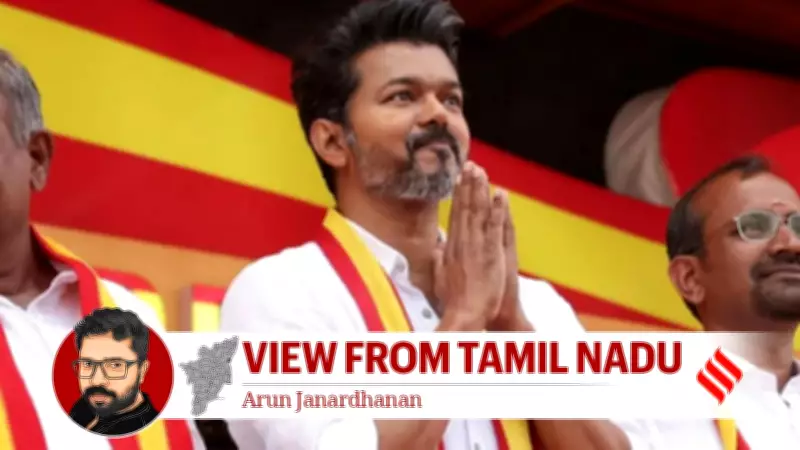
Vijay and the Limits of Political Logic: Why Tamil Superstar's Rise Has Bigger Parties Unsettled
The entry of actor-politician Vijay into Tamil Nadu's political arena is sending shockwaves through the state's established electoral frameworks. As the Assembly polls draw near, the leader of Tamilaga Vettri Kazhagam (TVK) is attempting to import cinema's emotional mechanics directly into politics, a move that has left traditional parties feeling distinctly uneasy. While arguments can be countered with logic, the intense longing and fan devotion that Vijay commands present a unique challenge that defies conventional political strategies.
The Electoral Landscape and TVK's Promising Scenario
Tamil Nadu's political scene, with elections just months away, appears neatly divided into four columns on paper. The ruling DMK alliance, the AIADMK–BJP combine, Tamil nationalist Seeman's Naam Tamilar Katchi (NTK), and the outlier: Vijay's TVK. The first three are familiar machines with decades of experience, booth agents, and caste arithmetic, while TVK is a recent phenomenon. Independent assessments suggest TVK could secure a 15-20% vote share, an astonishing figure for a barely structured party, if roughly a quarter of NTK voters shift towards Vijay. This potential surge also hinges on Dalit leader Thol Thirumavalavan MP's VCK and S Ramadoss's Vanniyar-based PMK losing votes to Vijay in northern Tamil Nadu, prompting even the giants, DMK and AIADMK, to brace for significant dents.
Minority voters further complicate the electoral math. Muslims are likely to largely remain with the DMK, while a substantial chunk of Christian voters may lean towards the superstar. Add first-time voters and young, urban men active on Instagram and reels to this mix, and the numbers being discussed around TVK do not seem far-fetched. However, the party faces challenges that could puncture this promising scenario, including scrambling for allies and reliance on a ready-made fan base, with advisers already speaking of Vijay as a Chief Minister-in-waiting.

The DMK's Puzzled Response and Unclassifiable Threat
For the first time in years, the Dravidian duopoly senses something it cannot easily classify—not a rival, not an ideology, not even a party, but perhaps a mood. Publicly, DMK sympathizers describe Chief Minister M K Stalin's response to the stampede at Vijay's rally in Karur last September as "mature," with him refusing to engage or trade barbs. Privately, however, there is unease. The DMK knows how to fight the AIADMK and the BJP, but it does not know how to combat a crowd that behaves as if it is in a movie, not politics.
When AIADMK leader Edappadi K Palaniswami's supporters allegedly manhandled ambulance staff last year, the state moved quickly with complaints, FIRs, and arrests—a familiar script. In contrast, after Karur, TVK functionaries named in complaints remain untouched, with the response feeling hesitant and puzzled. A senior DMK leader admitted, "This is not like fighting another party. This is something else," highlighting the unconventional nature of Vijay's appeal.
The Psychology of Fandom and Emotional Mechanics
Media scholar Dr. Gopalan Ravindran offers a sharp distinction: the relationship between cadre and leader is public, while that between a fan and a star is psychological. "When that becomes abnormal, it spills into public space," he says, a dynamic Vijay hopes to benefit from. Cinema creates what he calls an "absence–presence logic," where Vijay arrives not as ideology but as memory and habit, woven into one's sense of time. This explains the unprecedented crowds at his rallies, which are not entirely irrational.
Unlike other Tamil superstars like Rajinikanth or Ajith, who appear ordinary in public, Vijay maintains distance—framed like a character, not a citizen—building intense desire among fans. Author Perumal Murugan's account of the Karur stampede reveals telling details: some who collapsed and were revived asked first if Vijay had left, with a few pulling out glucose drips to run back. This is not voter reflex but the pursuit of a sighting, where politics produces arguments, but this produces pursuit.

Generational Shifts and Social Currency
Prominent Chennai-based psychiatrist Dr. Sivabalan Elangovan frames this in generational terms. For many teenagers and people in their twenties, attending a rally is not a political act but social currency. "In a life where everything happens inside the phone, being physically present somewhere big becomes proof that you exist," he says. A selfie with the campaign bus or a video post becomes the reward, driven by fear of missing out. Participation becomes content, and attendance becomes identity, with rallies less about governance and more about belonging.
Many women in their thirties and early forties, especially from lower-middle-class or rural backgrounds, treat these events as rare excursions—part outing, part escape, and part fantasy. For young women in Karur, it was simply "the one day I get to step out and see someone I've admired for years," offering relief rather than policy. This emotional connection risks being misread as irrational hype, with efforts to caricature Vijay's supporters.
Historical Context and Riskier Approach
Tamil Nadu has seen stars enter politics before, such as M G Ramachandran (MGR) and Jayalalithaa, but they came attached to movements, magazines, theatre circuits, and party cadres—a long political apprenticeship. MGR rose backed by the Dravidian movement's ideological machinery, and Jayalalithaa inherited that structure. In contrast, Vijay attempts something riskier: importing cinema's emotional mechanics directly into politics. This approach emphasizes aura over organization, crowd over cadre, intimacy over ideology, and charisma over conventional strategies.
This leaves established parties, even the formidable DMK, feeling oddly flat-footed, because while you can counter an argument, you cannot easily counter longing. As Tamil Nadu gears up for a pivotal election, Vijay's unconventional path challenges the very foundations of political logic, setting the stage for a contest where emotions may trump traditional arithmetic.