The Urdu press has launched a scathing critique of the ruling BJP on two major fronts this week: a public health tragedy in Madhya Pradesh and alleged electoral malpractice in Maharashtra. As the country gears up for a crucial election season, leading Urdu dailies Siasat and Urdu Times have highlighted issues of governance, accountability, and democratic integrity.
Indore Water Deaths: A Minister's 'Outrageous' Conduct
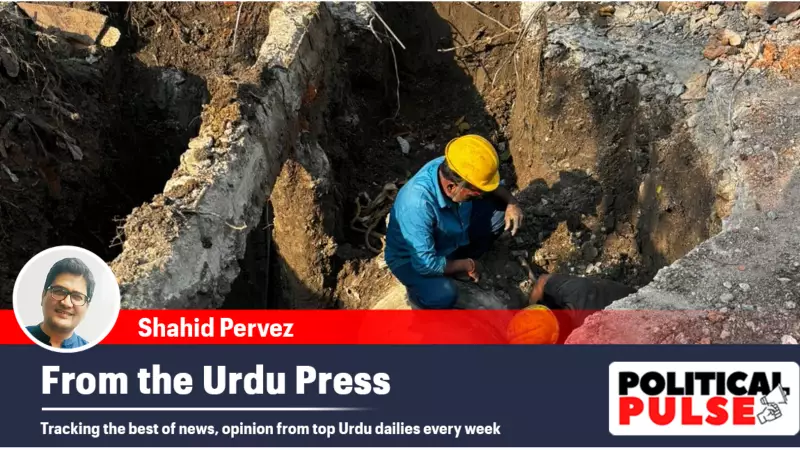
In a hard-hitting editorial dated January 2, 2026, Hyderabad-based Siasat addressed the water contamination crisis in Indore's Bhagirathpura area. The incident, caused by a leakage in the main water supply pipeline mixing with sewage, led to the deaths of at least 10 people and the hospitalization of over 200.
The newspaper expressed deep disturbance that such a failure could occur in a city consistently ranked among India's cleanest. "The BJP has been ruling the state for over two decades, and yet it seems it has not been able to address such fundamental public issues effectively," the editorial stated. It further criticized the reported struggle of affected residents to access proper medical care.

The editorial reserved its strongest condemnation for veteran BJP leader and state Urban Administration Minister Kailash Vijayvargiya, who is also the local MLA. It described his conduct as "outrageous", referencing his derogatory remark to a journalist questioning official accountability. Siasat argued that while Vijayvargiya has a history of controversial statements, he hit a new low on this critical public health emergency in his own constituency.
Despite his subsequent expression of regret, the daily said the comment was "condemnable" and revealed a mindset unaccountable to the public. It demanded that accountability be fixed not just on junior municipal officials—some of whom were removed—but also on legislators and ministers. The editorial called on the BJP leadership and Chief Minister Mohan Yadav to reprimand and rein in Vijayvargiya.
'Candidate Chori' in Maharashtra Civic Polls
Shifting focus to the electoral arena, Mumbai's Urdu Times, in its January 5 leader, raised alarms over the upcoming Maharashtra civic body polls. It pointed to an unprecedented development where 69 candidates were elected unopposed across various municipal corporations even before voting began.
Of these, a staggering 68 belong to the ruling Mahayuti alliance, with the BJP benefiting the most by winning 44 wards without a contest. The Eknath Shinde-led Shiv Sena secured 22 and the Ajit Pawar-led NCP got 2 seats unopposed.
The editorial noted that this phenomenon has stunned the Maharashtra State Election Commission, which has sought reports and halted the declaration of results for these wards. The development comes months after Rahul Gandhi's campaign against "vote chori" (vote theft).
The Opposition Maha Vikas Aghadi (MVA) has cried foul and approached the courts. Urdu Times posed the critical question: "How did so many Opposition candidates pull out of the fray?" It suggested possible inducements and called for a thorough probe into each withdrawal. "It seems the issue of 'vote chori' has now turned into 'candidate chori', which must be probed by our leading agencies," the edit stated, calling it a subversion of democracy that short-circuits the public mandate.
West Bengal: A War of Allegations
In its January 1 editorial, Siasat also turned its lens on the heated political battle in West Bengal ahead of the March-April Assembly elections. It noted the no-holds-barred, personal attacks exchanged between the ruling Trinamool Congress (TMC) and the principal Opposition BJP.
The newspaper highlighted Union Home Minister Amit Shah's serious allegation during a recent visit, where he accused the Mamata Banerjee-led government of abetting Bangladeshi infiltration for vote bank politics. Siasat questioned the legal follow-up to this charge pertaining to national security: "Why has Shah then not taken legal action against CM Mamata Banerjee?"

It also turned the spotlight on the Centre's responsibility, stating, "The Modi government has been in power for 12 years. If infiltration into the country is still taking place, it betrays the failure of the Centre." The editorial criticized the subsequent trading of allegations on issues like terror attacks, which it said debases politics. It concluded that political fights should be based on competing ideas and proposals, not personal vitriol.
Together, these editorials from the Urdu press paint a picture of a nation at a political crossroads, demanding greater accountability from its leaders on public welfare and democratic processes as a pivotal election year unfolds.