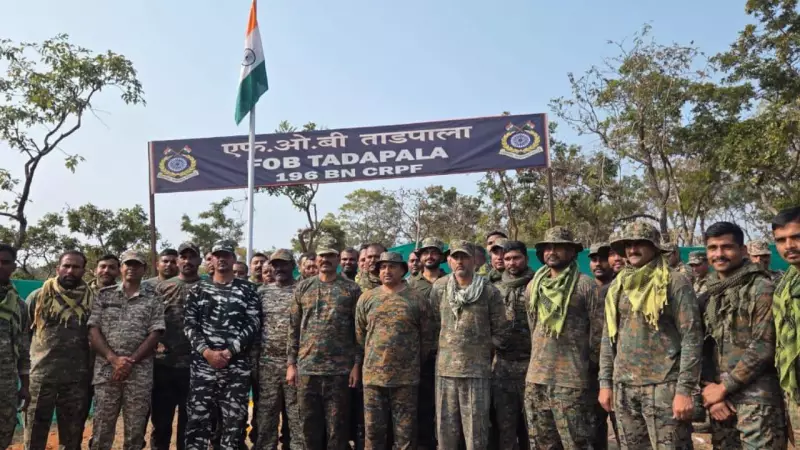
Tricolour Flies for First Time in 41 Former Maoist Villages on Republic Day
In a historic development, the national flag was unfurled for the very first time this Republic Day in 41 remote habitations across Chhattisgarh's Bastar region, areas that had long been under the shadow of Maoist control. This symbolic event marks a significant milestone in the state's efforts to reclaim these territories and integrate them into the mainstream democratic fabric of the nation.
From Karegutta Hills to Deep Forest Villages
The celebrations spanned from the once-impenetrable Karegutta hills in Bijapur district to the deepest forest villages of Bastar. The event gained profound significance as the Tricolour stood tall over the dreaded Karegutta Hills, where just days earlier, on Sunday, 11 security personnel had suffered injuries in an IED blast during an anti-Naxal operation.
The flag was hoisted at the newly established forward operating base (FOB) at Tadapala camp. For years, the Karegutta hills, situated at the helm of Bijapur district, served as a safe haven for Maoists, providing them with a base to camp, hide weapon dumps, and move freely across state borders.

Security Forces' Penetration and Establishment
This area witnessed a major breakthrough last year in March-April when security forces penetrated the region and eliminated over 30 Maoists in a rigorous 20-day-long anti-Naxal operation. Following this success, CoBRA commandos established an FOB there, solidifying the presence of state forces.
On Republic Day, the 196th battalion of CRPF and the 204th battalion of CoBRA proudly unfurled the flag on the Karegutta hills, asserting the authority of the Indian state in a region once dominated by insurgents.
Villages Embracing Democracy
The villages that celebrated Republic Day for the first time are spread across three districts:
- 13 in Bijapur
- 18 in Narayanpur
- 10 in Sukma
All these areas were long considered inaccessible for routine administration and national celebrations, cut off from the constitutional life of the country.
Police officials emphasized that this development reflects improved security conditions and the expanding presence of the state in interior tribal belts. These villages are now actively participating in the democratic and constitutional life of the nation, a shift made possible by sustained efforts over the past year.
Restoring Public Confidence and Governance
According to police sources, the establishment of security camps in and around these habitations has been central to restoring public confidence and enabling governance to reach the grassroots level. With regular patrolling and administrative outreach, villagers who once lived under the constant fear of Maoist reprisals are now engaging openly with state institutions.
Bastar range inspector general of police, P Sundarraj, highlighted that 13 villages in the region had unfurled the Tricolour for the first time on Independence Day in 2025. With the addition of 41 more this Republic Day, the total number of such villages has risen to 54, showcasing a steady progression in normalizing these areas.
Weakening of Maoist Influence
The police attributed the improved situation to sustained counter-insurgency operations and the weakening of Maoist leadership in traditional strongholds such as Abujhmarh and forested tracts adjoining national park areas. The elimination of several senior Maoist commanders over the past few years has significantly reduced the group's ability to intimidate local communities and disrupt governance.
"The celebration of Republic Day in these villages is not just symbolic," the IG stated. "It represents the victory of the Constitution, democracy, and rule of law, and the resolve of the people of Bastar to move forward on the path of peace and development."
This momentous occasion underscores a transformative phase in Chhattisgarh's conflict-ridden regions, where the national flag now flies as a beacon of hope, unity, and the enduring spirit of the Republic.