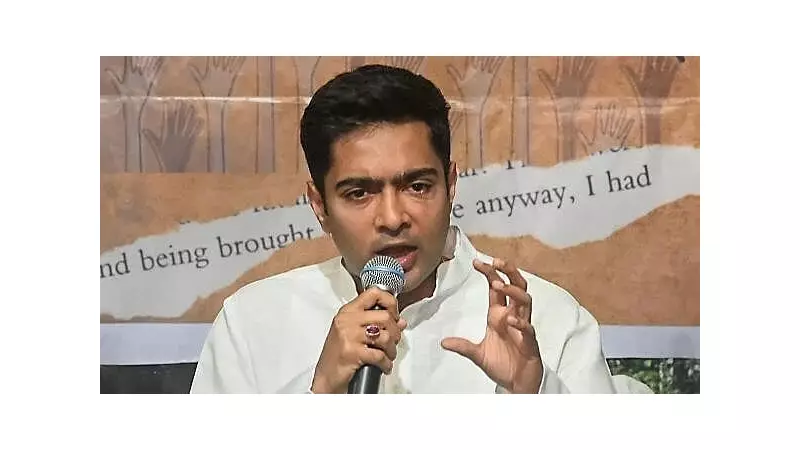
Trinamool Congress (TMC) national general secretary Abhishek Banerjee has launched a sharp critique against right-wing political forces, accusing them of poisoning the nation's social fabric through hate-mongering disguised as religious sentiment. His strong remarks came on a day marked by tragedy, coinciding with the recovery of the body of a migrant laborer from West Bengal who was lynched in Odisha.
A Statement Coinciding with Tragedy
Banerjee's political commentary was delivered on December 26, 2025. It directly intersected with a grim incident of mob violence. On the same day, the body of Juel Sheikh, a migrant worker hailing from West Bengal's Murshidabad district, was recovered. Sheikh was a victim of a brutal lynching in Sambalpur, Odisha.
The TMC leader did not explicitly link his statement to this specific case, but the timing underscored a broader narrative his party has emphasized. He argued that certain political elements are deliberately fostering an environment of intolerance and fear, using religion as a cover for divisive politics.

The Core Accusation: Hate in the Guise of Faith
In his address, Banerjee asserted that the country is being systematically fed a dangerous narrative. He claimed that right-wing forces are engaged in a campaign of "hate-mongering" which is corroding the secular and pluralistic ethos of India. By wrapping this rhetoric in the "garb of religion," these forces, according to him, are making their message more potent and socially acceptable to a section of the populace.
The implication is that such rhetoric can incite real-world violence and deepen communal fault lines. The tragic death of Juel Sheikh, a migrant worker far from home, serves as a somber backdrop to this warning, highlighting the potential human cost of unchecked inflammatory speech.
Political Repercussions and the National Discourse
This incident and the subsequent political statement are likely to fuel further debate in India's charged political landscape. The accusation places the spotlight squarely on the ruling Bharatiya Janata Party (BJP) and its ideological affiliates, whom the TMC frequently labels as the primary right-wing force in the country.
For the Trinamool Congress, which governs West Bengal, this is also a moment to consolidate its position as a staunch opposition voice against majoritarian politics. By highlighting the plight of a Bengali migrant worker, Banerjee also speaks directly to his home state's electorate, positioning the TMC as a protector of its people's interests and safety, even beyond state borders.
The coming days may see responses from other political quarters, especially the BJP, which has consistently denied allegations of promoting divisiveness and has countered by accusing opposition parties of minority appeasement. The lynching in Sambalpur will also put a focus on law and order issues and the protection of migrant workers across states.
Ultimately, Banerjee's comments reflect the deepening political polarization in India, where charges of "hate-mongering" and "communal poisoning" have become frequent tools of political rhetoric. The sad tale of Juel Sheikh provides a concrete, human dimension to this often abstract and heated political quarrel.