Budget 2026: Telangana's Call for Constitutional Justice and Fair Allocation
As Union Finance Minister Nirmala Sitharaman prepares to present the Union Budget 2026 this Sunday, expectations are running high across all Indian states regarding allocations, reforms, and the Centre's commitment to cooperative federalism. Among the states, Telangana has emerged as a vocal claimant, repeatedly raising concerns over what it describes as continued neglect in successive budgets, despite being one of India's fastest-growing states, now under Congress party rule.
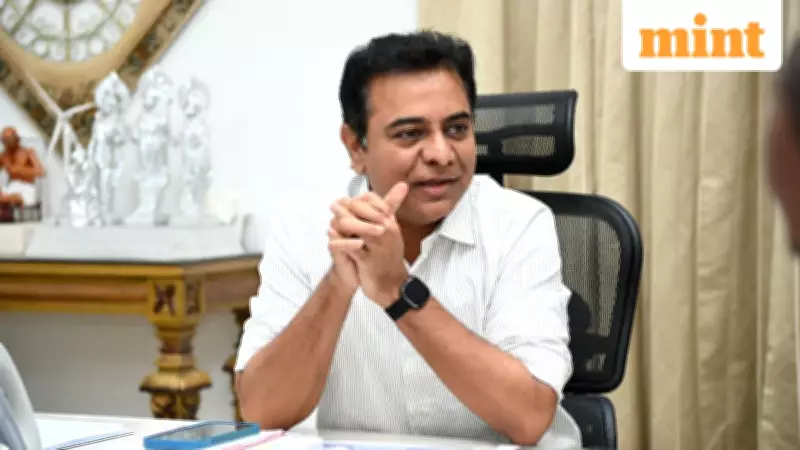
BRS Working President KT Rama Rao Outlines Key Demands
In an exclusive interview, BRS working president KT Rama Rao, the former IT Minister of Telangana, detailed the party's comprehensive expectations for Budget 2026. These range from pending commitments under the AP Reorganisation Act to GST compensation, rural employment funding, and much-needed middle-class tax relief. KTR emphasized that promises have historically been paraded like festivals but outcomes were abandoned like ruins for Telangana during both UPA and NDA governments.
Expectations from Finance Minister Nirmala Sitharaman's Budget
KTR stated: "A national budget is the mirror of the union government's philosophy. Our expectation from the Hon'ble Finance Minister is that Telangana be seen not as a marginal footnote in the Union's narrative, but as a cornerstone of India's economic architecture." He highlighted that despite Telangana's decade-long status as the fastest-growing state under BRS rule, it has consistently received minimal attention in Union Budgets. The unfulfilled promises of the AP Reorganisation Act, including national status for the Palamuru-Rangareddy project and the steel plant at Bayyaram, remain critical constitutional obligations rather than mere favors.

Strengthening Telangana's Growth Story
When asked if Budget 2026 would bolster Telangana's growth trajectory, KTR responded: "If the NDA government truly wishes to strengthen India's growth story, it must rise above selective federalism. To sideline Telangana is to dim a flame that has already lit the path of India's progress." He argued that the budget's impact depends on whether the Centre prioritizes vision over vote bank politics and fairness over favoritism. If treated as a campaign brochure for election-bound states, it will remain an exercise in political arithmetic; embracing cooperative federalism could elevate the entire nation.
Comparing UPA and NDA Budget Approaches
KTR offered a stark comparison: "When we analyse the Union Budgets of both the UPA and NDA, one truth emerges with clarity. Whether painted beneath the lotus or balanced on the hand of deception, the mirage has remained constant." He criticized Congress-led budgets for lacking the vision and urgency needed for economic miracles, with allocations that shimmered in rhetoric but collapsed in execution. Conversely, he accused the NDA of perfecting distorted federalism, deliberately sidelining high-performing states like Telangana while favoring politically expedient regions.
Transformative Reforms for Telangana's Economy
Identifying the single most crucial reform, KTR called for "a massive and unprecedented surge of investment, an infrastructure push for speed, scale, and vision, roaring like the engines of a new industrial revolution." He stressed that such urgency is foundational for building India's future prosperity.
VB-GRAM Rozgar Scheme and Rural Employment
Regarding the VB-GRAM Rozgar scheme, KTR labeled its current funding pattern as "a betrayal of federal fairness." By shifting wage and material burdens onto states, the Centre has turned a guarantee for the poorest into a gamble on state finances. He demanded a reversal, arguing that rural employment cannot depend on uneven state budgets.
Middle-Class Taxation Concerns
KTR described the middle class as "India's Atlas, carrying the weight of the economy on its shoulders." He urged the Finance Minister to address stagnant exemptions, rising indirect taxes, and shrinking deductions by widening tax slabs to match inflation, restoring meaningful deductions for housing and healthcare, and simplifying compliance to reduce paperwork burdens.

Pending AP Reorganisation Act Commitments
He emphasized that budgetary support for pending obligations, such as national status for irrigation projects, is a constitutional responsibility, not optional generosity. "When the Centre delays, it is not just denying funds, it is denying trust," KTR noted, recounting efforts by former Chief Minister KCR and himself to secure these commitments through meetings with central ministers.
GST Compensation Extension
On GST compensation, KTR asserted it is a matter of federal stability and people's dignity. "When GST was rolled out, states surrendered fiscal autonomy in good faith, on the assurance that the Union would stand by them during the transition," he said. Withdrawing compensation now, while reforms mature, breaks that bond and weakens cooperative federalism, disproportionately affecting states like Telangana with compressed revenues but constant obligations.
Key Takeaways from Telangana's Demands
- Telangana seeks equitable treatment in Budget 2026 to address perceived historical neglect.
- The BRS leader underscores constitutional obligations under the AP Reorganisation Act as non-negotiable.
- Critical demands include middle-class tax relief, rural employment funding, and extended GST compensation.
- The call for cooperative federalism highlights the need for vision over political expediency in national budgeting.