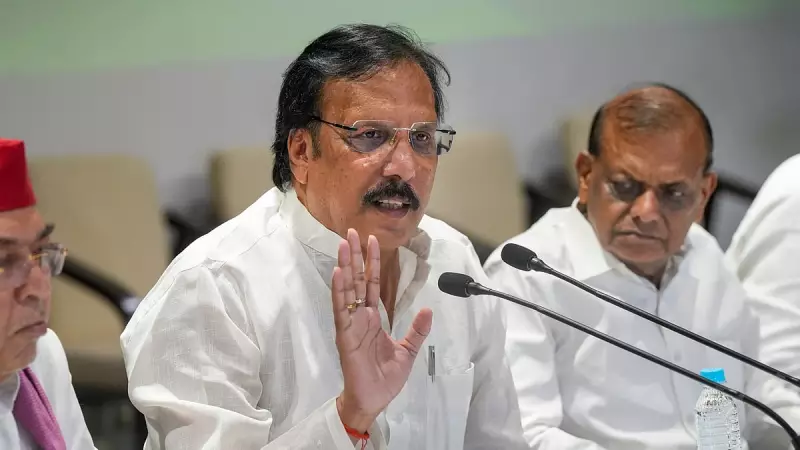
Samajwadi Party (SP) Member of Parliament Rajeev Rai has stirred a political debate with pointed remarks contrasting the governance approach of the Congress-led government in Karnataka with that of Bharatiya Janata Party (BJP)-ruled states. The MP's comments came just a day after he publicly criticized the Bengaluru police, offering a nuanced perspective on political tolerance and freedom of expression.
From Criticism to Commendation: A Swift Political Pivot
In a notable shift, Rajeev Rai, the SP MP from Ghosi in Uttar Pradesh, expressed appreciation for the political environment in Karnataka. His praise followed his own sharp critique of the Bengaluru police force, which he had previously labeled as "useless" for their handling of a traffic violation involving his convoy. The MP asserted that the very act of criticizing the police in this manner would have led to severe repercussions elsewhere.
"This would have earned me an FIR in BJP-ruled states," Rai stated, highlighting what he perceives as a key difference in administrative culture. He emphasized that the Congress government in Karnataka, under Chief Minister Siddaramaiah, demonstrated maturity by not initiating punitive legal action against him for his harsh words. This, he implied, stands in stark contrast to the alleged tendency in states governed by the BJP to use First Information Reports (FIRs) as a tool against critics.

The Context: A Traffic Stop and Escalating Tensions
The entire episode originated from a routine traffic incident in Bengaluru. On Tuesday, Rajeev Rai's convoy was reportedly stopped by traffic police for a violation. The situation escalated, leading to a heated argument between the MP's security personnel and the police officers on duty. Following this altercation, Rai launched a scathing attack on the Bengaluru police, questioning their effectiveness and professionalism.
However, the political narrative took an unexpected turn the very next day. Instead of facing backlash or legal notices from the state government, Rai found himself commending the Congress administration's forbearance. His remarks strategically positioned the Karnataka government as one that allows space for dissent and criticism, a fundamental aspect of democratic discourse, without resorting to immediate criminalization of opposing voices.
Broader Implications for Political Discourse and Federalism
Rai's statements transcend the immediate incident, touching upon larger themes of political vendetta, freedom of speech for elected representatives, and the varying styles of governance across different Indian states. By framing his experience in Karnataka as an exception, he indirectly levels a serious allegation against BJP-led state governments, suggesting a more authoritarian approach to handling criticism.
This incident occurs in a highly charged national political atmosphere, where accusations of using state machinery to silence opponents are frequently exchanged. The SP MP's comments are likely to be leveraged by the Congress and other opposition parties to bolster their narrative against the BJP. It paints a picture of the Congress party in Karnataka as a defender of democratic values, a potent message in the ongoing ideological battle.
The Karnataka government, for its part, has not officially reacted to Rai's praise. Their silence can be interpreted as a strategic acceptance of a positive narrative, even if it comes from an MP who had just denounced their police force. The Bengaluru police also have not issued any further statements on the matter, allowing the political commentary to take center stage.
Ultimately, Rajeev Rai's juxtaposition of Karnataka's Congress rule with BJP-governed states serves as a microcosm of the larger political divisions in India. It highlights how individual administrative actions, or inactions, are amplified into national symbols of governance models. Whether this incident remains a fleeting remark or becomes a sustained talking point in the opposition's arsenal remains to be seen, but it has undoubtedly added a new layer to the debate on political tolerance in India's federal structure.