Amit Shah Dismisses Development Link to Maoist Issue, Reaffirms March 2026 Deadline
Union Home Minister Amit Shah, during a high-profile visit to Chhattisgarh, categorically rejected the notion that the Maoist problem is connected to lack of development or poor law and order. He emphasized that Left Wing Extremism is fundamentally an ideology-driven challenge that requires immediate eradication from the country.
Ideological Battle, Not Development Deficit
Speaking at an event titled 'Chhattisgarh@25: Shifting The Lens', organized by the Organiser, Shah challenged prevailing narratives. "Some thinkers spread the misconception that the Maoist issue is linked to development and that it is an issue of law and order. But it's not the case," he asserted. The Home Minister argued that misdiagnosing the problem would constitute injustice to future generations.
Shah presented historical context to support his argument. He recalled that during the 1980s, when Maoist influence expanded into bordering districts of present-day Telangana, Maharashtra, Chhattisgarh, Andhra Pradesh, and Odisha, there were over 100 districts more backward than Bastar. "If the root cause of the problem is development, then when the problem grew, why did it not grow in those 100 districts that were more underdeveloped than Bastar?" he questioned.

Law and Order Statistics Debunked
The Union Minister also dismissed the law-and-order explanation. "Before the emergence of the Maoist problem, Bastar's law and order statistics were much better than those of many districts of Bihar and Uttar Pradesh," he stated. Shah expressed willingness to debate anyone on this matter, promising to substantiate his position with facts and evidence.
He pointed to the very nomenclature of the movement as proof of its ideological foundation. "Those who say there is no ideological problem should explain why this movement was named Maoism. Because within this ideology lies the belief that solutions to problems emerge from the barrel of a gun," Shah elaborated.
Communist Ideology as Destructive Force
Shah characterized Communist ideology as inherently destructive. "Left-wing extremism is an ideology-driven challenge. Wherever Communists remained in power, they could not bring development. Communist ideology is an ideology indicative of destruction, and the country needs to get rid of it immediately," he declared.
The Home Minister noted that Communist ideology has largely disappeared from democratic politics across India. "It does not exist in Tripura and Bengal. In Kerala, it is surviving to an extent; however, people have started the change from Thiruvananthapuram," he added, referencing the BJP's recent civic poll victories in the state capital.
Political Accusations and Development Vision
Shah accused the previous Congress government led by Bhupesh Baghel of sheltering Maoist elements. "I was the Union Home Minister even during Bhupesh Baghel's tenure. I can say with full responsibility that the Congress government sheltered Maoist terror," he claimed.
Contrasting this with the current scenario, Shah expressed confidence in Bastar's transformation. "I have no hesitation in saying that if Bastar was not affected by the Maoist problem, it would have been the most developed district in the country. After 10 years, look at Bastar. It is going to become the most developed tribal region," he predicted.
March 2026 Deadline and Security Strategy
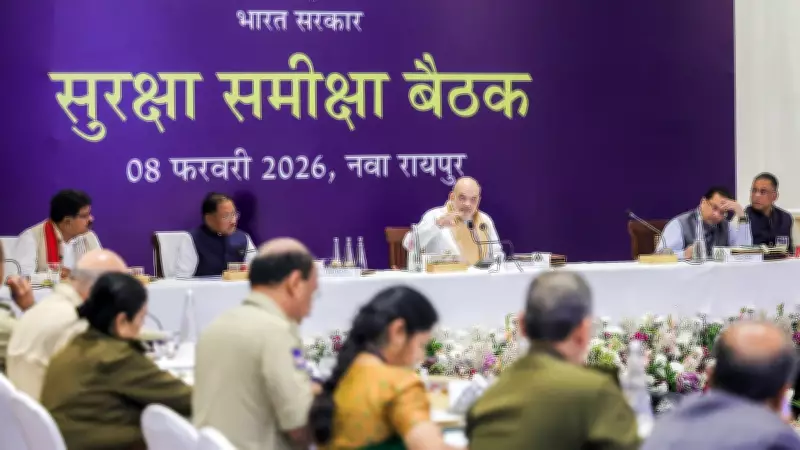
During his three-day visit to Chhattisgarh, Shah chaired a crucial security review meeting on Left Wing Extremism in Raipur. He revealed that 90 percent of Naxalite-dominated areas have already been liberated, with complete eradication targeted by March 31, 2026.
The Home Minister stressed the importance of coordinated efforts among security agencies. He instructed that remaining Naxalites must not be allowed to flee to neighboring states, and the anti-Naxal campaign must maintain its unified focus.
Shah highlighted the effectiveness of the current strategy, which combines:

- Enhanced security operations with thousands of additional forces deployed since 2023
- Targeted strikes on Naxalite financial networks
- Infrastructure development in affected regions
- A comprehensive surrender policy for militants
Operational Successes
The security-centric approach has yielded significant results. Between 2024 and 2025, security forces eliminated over 500 Naxalites, including high-profile leaders such as:
- Basava Raju, then general secretary of the banned CPI (Maoist)
- Military leader Madvi Hidma
- Several central committee members of the organization
Shah expressed unwavering confidence that Naxalism would be completely eliminated before the March 2026 deadline, marking a definitive end to this decades-long security challenge.