Amit Shah Delivers Sharp Ideological Critique of Maoism at Raipur Conclave
Union Home Minister Amit Shah mounted a pointed ideological critique of Maoism on Sunday, firmly asserting that Left-wing extremism (LWE) is neither a consequence of underdevelopment nor merely a law-and-order issue. Instead, he characterized it as a product of an ideology that rejects constitutional methods and legitimizes violence as a political tool.
Rejecting the Development Narrative
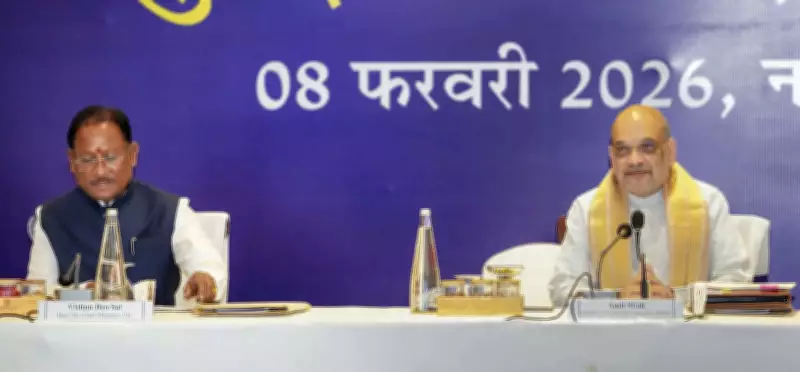
Speaking at the national conclave ‘Chhattisgarh @ 25: Shifting the Lens’ in Raipur, Shah declared the belief that Maoist violence stems primarily from a lack of development as "misleading and dangerous." He argued this perspective ignores both historical data and ground realities. "If ideology was not the problem, why is this movement called Maoism?" he questioned, emphasizing that the insurgency derives its logic from a belief system seeking solutions through the gun rather than democratic debate and the Constitution.
Shah provided historical context, noting that when LWE began spreading in the 1980s, Bastar was not India's most underdeveloped region. "At that time, more than 100 districts in the country were more backward than Bastar, yet Maoism did not take root there," he contended, stating the insurgency expanded selectively due to ideological mobilization.

Accusations Against Congress and Appeals for Surrender
The Home Minister escalated his attack on the Bhupesh Baghel-led Congress government in Chhattisgarh, alleging the administration "gave shelter" to Maoists, a charge he said he makes without hesitation. On intensified security operations, Shah clarified the government does not seek bloodshed and prefers surrender over confrontation.
"We do not want to fire bullets," he stated, appealing directly to armed Maoists to lay down their weapons. "If all armed Maoists surrender, we will welcome them on a red carpet." Making a specific appeal to women cadres, he added, "I request women Maoists to come forward — a great life is waiting for you."
Constitutional Duty and Claims of Progress
Shah simultaneously affirmed the state's constitutional obligation to act when armed groups take law and order into their own hands. "If weapons are raised against the state and the people, it is the government's duty to provide security," he asserted. He then made a significant claim, stating that nearly 90% of the Maoist problem has already been resolved ahead of the Centre's March 31 deadline to root out LWE.
Rejecting attempts to frame Maoism as a spontaneous tribal uprising, Shah accused Maoist groups of systematically destroying institutions meant to empower local communities. "They burnt primary schools, shut down PHCs and CHCs, and ensured that two generations of tribal children remained illiterate in Bastar," he detailed, adding that welfare delivery—including ration cards, bank accounts, housing, and healthcare—was blocked for years as Maoists prevented state entry into large swathes of Bastar.
Ideological Contrast and Future Commitment
The Home Minister emphasized that Maoist ideology promotes armed struggle as the only path, directly contradicting constitutional values. "Every problem in India has a solution through the Constitution and debate," Shah stated. "But they handed guns to poor tribal children and youth, spreading the slogan of a ‘red corridor’ from Tirupati to Pashupati, sitting like a cobra with its hood spread for 40 years."
Shah pointed out that India has witnessed governance shaped by three ideological streams—Congress, BJP, and communists—over 75 years. He claimed comparative performance data would show the BJP has performed best, while regions governed by communist ideology failed to deliver development despite welfare rhetoric. "The ideological legacy of Maoism and communism has brought only darkness wherever it went. And the shrinking footprint of communist politics in India reflected public rejection of that worldview," he stated.

He reiterated the Centre's commitment to eliminate the remaining Maoist presence by March 31, 2026, but stressed that dismantling the insurgency's ideological appeal is as crucial as neutralizing armed cadres. The comprehensive address framed the conflict as a fundamental clash between constitutional democracy and violent extremism, with the government claiming substantial tactical and ideological gains.