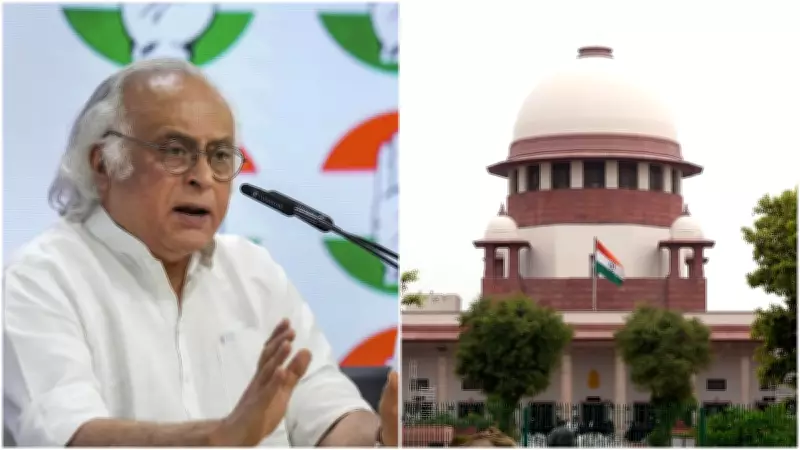
Supreme Court Rebukes Congress MP Jairam Ramesh Over Retrospective Environmental Clearance Petition
The Supreme Court of India has issued a sharp rebuke to Congress Member of Parliament Jairam Ramesh regarding his legal plea challenging the practice of granting retrospective environmental clearances. During the hearing, the court expressed skepticism about the timing and intent of the petition, with justices remarking, "We know the design" in response to the arguments presented.
Legal Arguments and Court's Scrutiny
In the proceedings, Jairam Ramesh's counsel argued that ex-post facto environmental clearances are fundamentally "wrong" and violate established legal principles. The counsel further contended that the cause of action for filing the plea only arose after a recent judgment on the matter, stating, "so I could only file after the judgment." This justification was put forth to address questions about the delay in submitting the petition.
However, the Supreme Court bench appeared unconvinced by this reasoning. The justices raised pointed questions about the strategic timing of the plea, suggesting it might be politically motivated rather than purely based on environmental concerns. The court's remarks highlighted a broader scrutiny of how environmental laws are being leveraged in legal and political arenas.

Implications for Environmental Governance
This case brings to the forefront critical issues in India's environmental governance framework. Retrospective clearances, which approve projects after they have already commenced or been completed, have long been a contentious topic. Critics argue that such practices undermine the purpose of environmental impact assessments and can lead to ecological damage.
- The Supreme Court's response indicates a growing judicial wariness towards petitions that may be perceived as politically timed.
- Environmental activists and legal experts are closely watching this case, as it could set precedents for how similar issues are handled in the future.
- The outcome may influence policy discussions on strengthening environmental compliance and transparency in project approvals.
As the legal battle unfolds, it underscores the ongoing tension between development projects and environmental protection in India. The Supreme Court's final decision on this plea is awaited, with potential ramifications for both political accountability and environmental jurisprudence.