

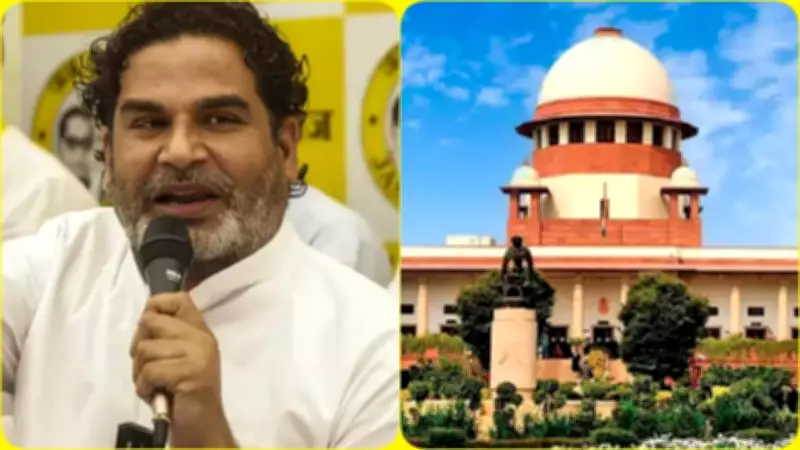
Supreme Court Dismisses Jan Suraaj Party's Petition Challenging Bihar 2025 Assembly Elections
The Supreme Court of India on Friday firmly declined to entertain a petition filed by Prashant Kishor's Jan Suraaj Party (JSP) that sought to challenge the results of the 2025 Bihar assembly elections. A bench comprising Chief Justice of India Surya Kant and Justice Joymalya Bagchi refused to issue any directions for annulling the election outcomes or ordering fresh polls across the state.
Court's Stern Observations on Political Motives
During the proceedings, Chief Justice Surya Kant made pointed observations about the petition's intent. "How many votes did your political party get? People reject you and then you use judicial platform to get popularity," the CJI remarked, as reported by PTI. The bench emphasized that it could not issue broad directives for an entire state based on a political party's request.
"We cannot issue an omnibus direction for the entire state that too at the instance of a political party," Justice Kant added, underscoring the court's position on maintaining judicial boundaries in electoral matters.

Jan Suraaj Party's Allegations and Claims
The Jan Suraaj Party had approached the apex court seeking fresh elections after alleging serious violations by the Bihar government. The party contended that the state administration breached the Model Code of Conduct (MCC) by transferring Rs 10,000 to women beneficiaries under the Mukhyamantri Mahila Rojgar Yojana after the election schedule was officially announced.
According to the petition, this financial disbursement constituted a corrupt practice that severely disturbed the level playing field essential for free and fair elections. The scheme, designed to provide an initial grant of Rs 10,000 to women for promoting self-employment and small businesses, allegedly saw the debt-ridden state government distribute Rs 15,600 crore on the eve of polls.
The JSP argued that this move directly influenced voters in violation of Article 324 of the Constitution and Section 123 of the Representation of the People Act, which govern electoral conduct and procedures.
Court's Directive and Alternative Legal Pathway
Despite these allegations, the Supreme Court bench clarified that it would not entertain a writ petition on this specific issue. The court advised the Jan Suraaj Party to instead approach the Patna High Court, noting that the matter pertained exclusively to one state's electoral process and fell within the appropriate jurisdiction of the state's high court.
This judicial direction reinforces the established legal hierarchy where state-specific electoral disputes are typically addressed first at the high court level before potentially moving to the Supreme Court.
Background: Bihar 2025 Assembly Election Results
The political context of this petition is significant. In the 2025 Bihar assembly elections for the 243-member legislative assembly:
- The BJP-led National Democratic Alliance (NDA) retained power decisively, winning 202 seats.
- The opposition INDIA bloc secured 35 seats in the assembly.
- The Jan Suraaj Party failed to win a single seat, with most of its candidates forfeiting their security deposits due to insufficient votes.
The election outcome highlighted the JSP's limited electoral presence despite its high-profile leadership under political strategist Prashant Kishor, who founded the party after his extensive work with various political organizations across India.
Legal and Political Implications
This Supreme Court decision carries several important implications:

- Judicial Restraint: The ruling demonstrates the judiciary's cautious approach toward intervening in electoral processes, particularly when petitions come from political parties with minimal electoral success.
- Electoral Accountability: The court's remarks underscore that electoral outcomes should primarily reflect popular will rather than judicial intervention.
- Legal Procedure: The directive to approach the Patna High Court reaffirms proper legal channels for addressing state-level electoral grievances.
- Political Strategy: The episode reveals how emerging political parties might utilize legal avenues to challenge established electoral outcomes and gain visibility.
The Supreme Court's refusal to intervene in this case maintains the constitutional balance between judicial oversight and electoral democracy, while providing clear guidance on appropriate legal remedies for future similar disputes.





