NEW DELHI: The Republic Day celebrations in 2026 were as grand as ever, yet they carried a distinct and sharper message compared to previous years. This year's display of India's military strength was set against the significant backdrop of Operation Sindoor, launched in May 2025. While the government has described the operation as "paused," Prime Minister Narendra Modi had earlier emphasized that it is far from over, adding a layer of strategic significance to the festivities.
IAF's 'Sindoor' Formation Steals the Show
The Air Force captivated the audience with a special "Sindoor" formation during the Republic Day flypast. This formation included two Rafale jets, two MiG-29 fighters, two Su-30 aircraft, and one Jaguar, all flying in a precise "Spearhead" formation. The flypast was dedicated to honoring the IAF's crucial role in Operation Sindoor, a four-day military confrontation with Pakistan that followed the Pahalgam terror attack.
Ground and Air Integration in Battle Array Format
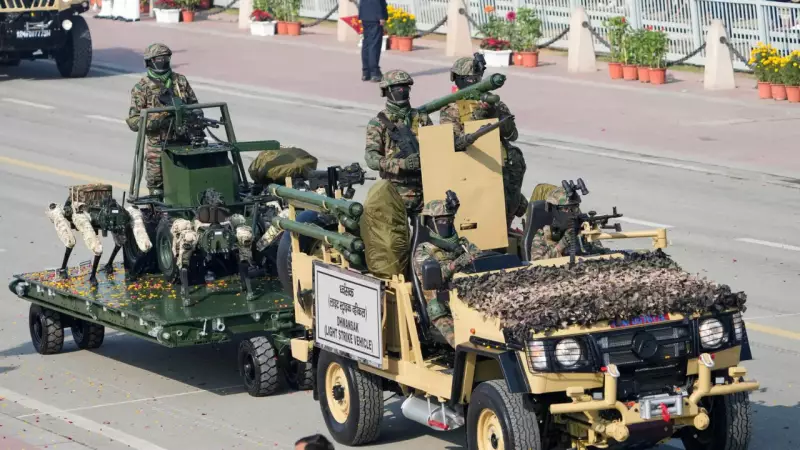
For the first time in Republic Day history, the parade showcased the Army's phased "Battle Array Format," which seamlessly integrated ground forces with aerial elements. The display featured a high-mobility reconnaissance vehicle and India's first indigenously developed armoured light specialist vehicle, highlighting advancements in ground combat capabilities.

Aerial support was robustly provided by the indigenous Dhruv Advanced Light Helicopter and its armed variant, Rudra, flying in the Prahar formation. This demonstration illustrated how air power is strategically used to shape the battlefield before ground forces advance, showcasing enhanced coordination.
Showcasing India's Combat Prowess
The combat segment of the parade was a formidable display, with T-90 Bhisma tanks and the Arjun Main Battle Tank rolling past the saluting dais. These ground units were supported from the air by Apache AH-64E attack helicopters and the Prachand light combat helicopter, emphasizing multi-domain operations.
Other mechanized units on display included the BMP-II Infantry Combat Vehicle and the tracked version of the Nag missile system (Mk-2). The aerial components underlined India's growing ability to deliver precise and powerful support to ground forces across various operational environments, enhancing battlefield effectiveness.
RUDRA: A Key Battlefield Force Multiplier
RUDRA, an armed version of the Advanced Light Helicopter (ALH) Dhruv, is considered one of India's key battlefield force multipliers. It is especially effective when operating in coordination with the Indian Air Force, missile systems, and artillery units. Designed to provide close air support to troops on the ground, RUDRA is capable of targeting enemy infantry, armoured vehicles, tanks, and even hostile helicopters, thereby protecting friendly forces during operations.
Historic EU Participation in the Parade
The parade made history by featuring a military contingent from the European Union, marking the EU's first-ever participation in a military parade outside Europe. The contingent carried military staff flags along with the flags of EU naval operations Atalanta and Aspides, symbolizing strengthened international military ties.
Among the major weapons systems showcased were the Suryastra Universal Rocket Launcher System (URLS), the BrahMos supersonic cruise missile, and the Akash air defence missile system, further highlighting India's advanced defence capabilities.
The event was attended by European Commission chief Ursula von der Leyen and European Council president Antonio Costa, alongside India's top leadership including Prime Minister Narendra Modi, Defence Minister Rajnath Singh, senior cabinet members, and President Droupadi Murmu. The President unfurled the Tiranga at Kartavya Path, continuing the long-standing tradition of the Republic of India, amidst a display that blended tradition with modern military strategy.