

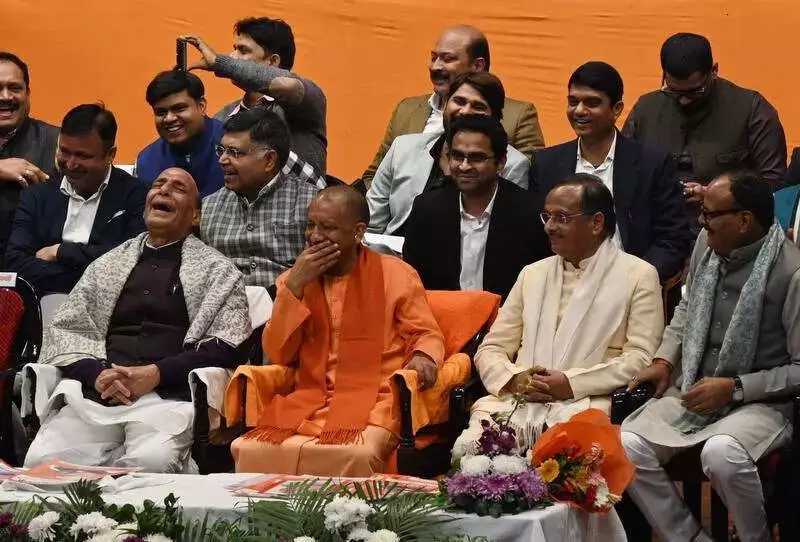
Defence Minister Rajnath Singh paid a heartfelt tribute to former Prime Minister and Bharat Ratna Atal Bihari Vajpayee on Tuesday, delving into the literary depth and enduring values of the late leader. The occasion was the Ekal Kavya Path event, organized in Lucknow on the eve of Vajpayee's birth anniversary.
Vajpayee's Early Genius and Lucknow Connection
Rajnath Singh shared a lesser-known fact about Vajpayee's poetic beginnings. He revealed that Atal Bihari Vajpayee penned his first well-known poem, "Hindu Tan-Man, Hindu Jeevan," while he was just a student in Class 10. The Defence Minister noted that scholars who heard the poem in those early years sensed that young Atal was no ordinary individual but a person destined to shape India's future.
Singh also recalled a memorable moment from 1942 when Vajpayee recited this poem at a camp in Kalicharan College. The entire hall reportedly echoed with applause, offering an early glimpse of his powerful oratory. The minister highlighted Vajpayee's deep connection with Lucknow, mentioning that many senior citizens of the city had personal or professional interactions with him.

Poetry of Principle and Inspiration
The Defence Minister illustrated how Vajpayee's poetry was a reflection of his life's philosophy. He quoted the famous lines, "Chhote man se koi bada nahi hota, toote man se koi khada nahi hota", emphasizing that they continue to inspire people today. Referring to Vajpayee's poem "Unchai" (Height), Singh explained the former PM's belief that reaching great heights should not lead to isolation.
"Atal ji always believed that reaching great heights should not lead to isolation," Singh stated. Vajpayee stressed that height must be accompanied by expansion, ensuring one remains connected with society and walks alongside others.
A Leader Defined by Character, Not Position
Rajnath Singh described Vajpayee as a leader whose respect was earned through personality and deeds, not merely the offices he held. He used the analogy of the number '111' to explain this, stating that while the value of a digit changes based on its position, Atal ji's worth was always defined by his character, not his position.
Singh observed that while programs marking the birth anniversaries of great leaders are often formal, events in memory of Atal Bihari Vajpayee naturally take on a warm and lively atmosphere, mirroring his simple and affectionate nature.
He also spoke about Vajpayee's unique ability to retain the softness of poetry amid the noise and pressure of public life. While he left a deep imprint on the nation as a popular leader, he also won hearts through his verses. Lines like "Haar nahi maanunga, raar nahi thaanunga" reflected his unwavering determination even in difficult times.
The Defence Minister fondly recalled Vajpayee's sense of humour, citing incidents from the Emergency period and later political life. He noted that despite being a serious and principled figure, Vajpayee often conveyed profound messages with wit and grace, never crossing the limits of decorum. Rajnath Singh concluded by affirming that Vajpayee remains a guiding light in Indian politics, whose ideals will continue to inspire future generations.
The event saw a distinguished gathering, including Chief Minister Yogi Adityanath, Deputy Chief Minister Brajesh Pathak, BJP state president Bhupendra Chaudhary, poet Kumar Vishwas, and mayor Sushma Kharakwal, among others.






