

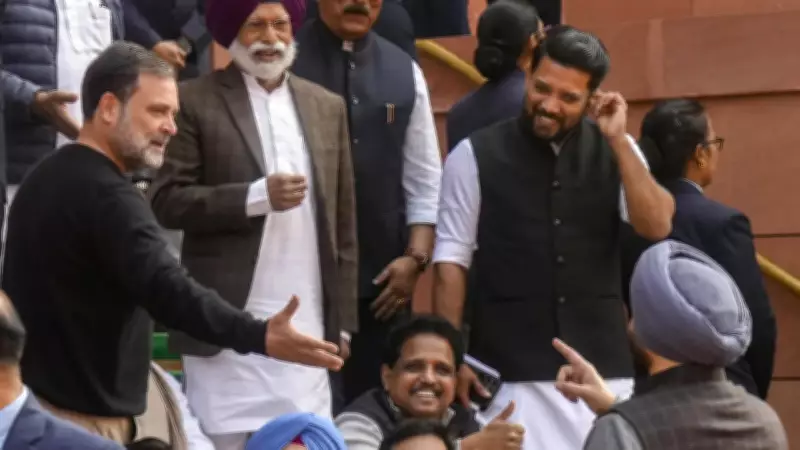
Congress leader Rahul Gandhi ignited a fresh political firestorm on Wednesday after engaging in a heated verbal exchange with BJP MP Ravneet Singh Bittu outside Parliament, where he labeled the BJP parliamentarian a "traitor friend." The confrontation occurred during protests at the Makar Dwar of the Parliament complex, where Congress MPs were demonstrating against the suspension of their colleagues.
Parliament Complex Confrontation Escalates
The war of words reportedly began when Bittu commented on the protesting MPs, stating, "They are sitting as if they won a war." This remark provoked Rahul Gandhi, who responded by calling Bittu a "traitor." In retaliation, Bittu fired back, describing Rahul Gandhi and Congress MPs as "Sadak ka gunda" (street thugs). The exchange quickly escalated beyond personal insults to touch upon deeper historical and community sensitivities.
BJP Leaders Launch Sharp Counterattack
Sikh leaders within the BJP immediately condemned Rahul Gandhi's remarks as "unacceptable" and deeply offensive to the Sikh community. Union Minister Hardeep Singh Puri held a press conference demanding an apology from the Congress leader, emphasizing the gravity of the term "traitor."

"This word, traitor, cannot be taken lightly. The word is used for someone who has betrayed his country. This is a very sensitive issue for the Sikh community," Puri stated emphatically.
The Union Minister highlighted Bittu's family legacy, noting that "Ravneet Singh Bittu is not just an MP elected from Ludhiana, he is not just a member of a Sikh family that has served the country. His grandfather, Sardar Beant Singh, who was the chief minister of Punjab, fell to an assassin's bullet. And you call him a traitor. This is unacceptable."
Bittu Recalls 1984 Anti-Sikh Riots
Countering Rahul Gandhi's allegations, Bittu invoked the painful memories of the 1984 anti-Sikh riots, accusing the Congress party of historical atrocities against Sikhs. "They think they are the biggest patriots. I said, you are the biggest traitor of this country, the murderers of Sikhs," Bittu declared.
He continued with emotional intensity: "His goons killed thousands of Sikhs in this country. They vandalised our most sacred Gurudwara. When workers used to chant 'shaheed' for Rajiv Gandhi, they also used to call Sardar Beant Singh 'Shaheed-e-azam'. The problems in Punjab, the terrorism there - Sikhs were called, but action was not taken. So, it was Sardar Beant Singh who calmed Punjab."
Bittu also pointed to what he perceived as political hypocrisy, remarking: "You were fine when I was with you, but now that I am in the BJP, you are using such language. After such remarks, he is offering his hand as if he were a king."
BJP Stages Protest at Congress Headquarters
In response to the controversy, BJP leaders and workers staged a significant protest near the Congress headquarters on Akbar Road. Demonstrators gathered at Mansingh Road, raising slogans including "Sikh Sardar Hai, Rahul Gandhi Gaddar Hai" (Sikhs are leaders, Rahul Gandhi is a traitor), and demanded a formal apology from the Congress leader in the Lok Sabha.
Delhi BJP president Virendra Sachdeva, who led the protest, asserted that "Gandhi not just abused an individual but the entire Sikh community, which is the pride of the country." The protest underscored the BJP's strategy of framing the incident as an insult to the Sikh community rather than merely a personal political dispute.
Political Implications and Community Sensitivities
This controversy has significant political ramifications as it:
- Revives painful historical memories of the 1984 anti-Sikh riots
- Highlights the sensitive nature of political discourse involving minority communities
- Demonstrates how personal political confrontations can escalate into broader community issues
- Shows the BJP's quick mobilization around perceived insults to Sikh identity
The incident occurs at a time when political tensions are already high due to the suspension of Congress MPs, adding another layer of complexity to parliamentary proceedings. Both parties appear to be using this confrontation to rally their respective bases while appealing to broader community sentiments ahead of crucial political battles.






