Congress Leader Rahul Gandhi Calls for Clear Moral Stance from Modi Government Amid Escalating Middle East Tensions
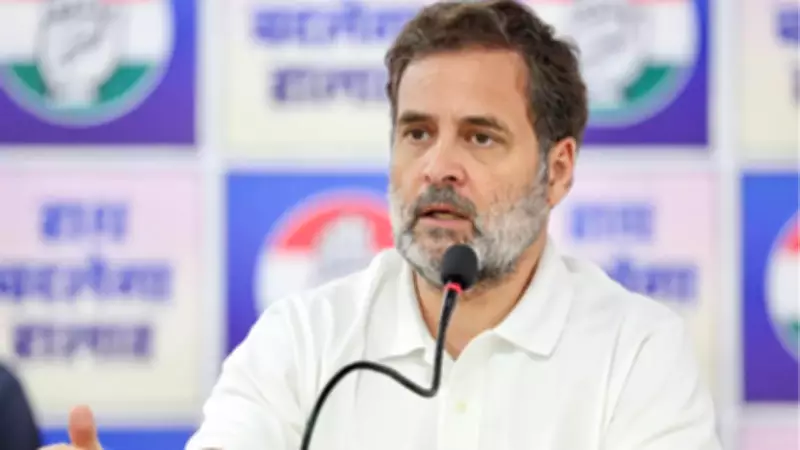
Congress leader Rahul Gandhi on Tuesday issued a strong appeal to Prime Minister Narendra Modi's government, urging it to adopt a clear and morally grounded position as hostilities intensify between the United States, Israel, and Iran. The political leader emphasized that the volatile situation threatens to plunge the entire region into broader conflict, with significant implications for global stability.
Warning of Regional Conflict and Impact on Indian Citizens
In a detailed post on social media platform X, Rahul Gandhi expressed deep concern about the deteriorating security landscape. "Escalating hostilities between the United States, Israel and Iran are pushing a fragile region toward wider conflict," he stated. "Crores of people, including nearly a crore Indians, face uncertainty due to these developments."
The Congress leader highlighted that while legitimate security concerns exist, actions that violate national sovereignty only exacerbate crises. "The unilateral attacks on Iran, as well as Iran's attacks on other Middle Eastern nations, must be condemned unequivocally," Gandhi asserted. "Violence begets violence - dialogue and restraint remain the only sustainable path to genuine peace."

Emphasis on India's Foreign Policy Traditions and Moral Clarity
Rahul Gandhi stressed that India's longstanding foreign policy traditions demand unambiguous clarity during periods of global instability. "India must be morally clear," he declared. "We should have the courage to speak plainly in defence of international law and human lives. Our foreign policy is fundamentally rooted in sovereignty and the peaceful resolution of disputes - and it must remain consistently true to these principles."
Direct Challenge to Prime Minister Narendra Modi
In a pointed remark directed specifically at Prime Minister Narendra Modi, Rahul Gandhi questioned the government's official position regarding recent geopolitical developments. "PM Modi must speak up and clarify his stance," Gandhi insisted. "Does he support the assassination of a head of state as an acceptable method to define the world order? Silence at this critical juncture diminishes India's standing and influence in the international community."
Recent Military Developments and Regional Impact
Meanwhile, the Ministry of External Affairs confirmed on Tuesday that limited flight operations have resumed from Dubai despite continued airspace disruptions across the region. This announcement comes amid reports of significant military actions.
According to available information, the United States and Israel conducted coordinated airstrikes across multiple Iranian cities on February 28. These strikes reportedly targeted:
- Military command and control centers
- Advanced air-defense systems
- Strategic missile launch sites
- Key regime infrastructure facilities
The military operations resulted in the death of Iranian Supreme Leader Ayatollah Khamenei along with four senior military and security officials. Large explosions were reported in Tehran and several other major Iranian cities, indicating the scale and intensity of the attacks.
Broader Regional Implications and Security Concerns
The escalating tensions have created ripple effects throughout the Middle East, with neighboring countries monitoring developments closely. The situation has raised concerns about:
- Potential disruption to global energy supplies and oil markets
- Safety and security of Indian expatriate communities in the Gulf region
- Impact on international diplomatic efforts and peace initiatives
- Possible humanitarian consequences for civilian populations
Rahul Gandhi's intervention highlights growing domestic political pressure on the Indian government to articulate a coherent foreign policy response to the rapidly evolving crisis. As one of the world's largest democracies with significant strategic interests in the Middle East, India's position carries substantial weight in international diplomatic circles.

The Congress leader's statement reflects broader concerns within India's political establishment about maintaining the country's traditional foreign policy principles while navigating complex geopolitical challenges. With millions of Indian citizens living and working in the affected regions, the government faces mounting expectations to ensure their safety while upholding India's commitment to peaceful conflict resolution.