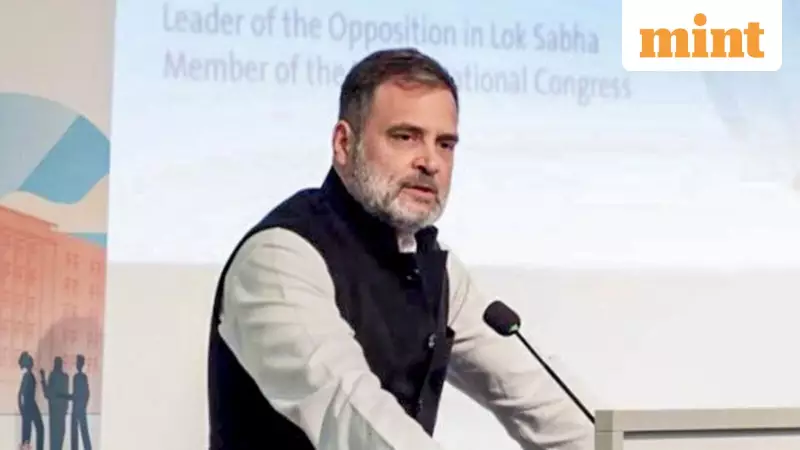
In a significant address on the international stage, Congress leader and Leader of the Opposition in the Lok Sabha, Rahul Gandhi, launched a sharp critique of the ruling Bharatiya Janata Party (BJP), alleging a systematic "assault" on India's democratic institutions. Speaking at the Hertie School in Berlin, Germany, last week, Gandhi claimed the BJP's actions pose a threat not just domestically but to the global democratic framework.
Allegations of Institutional Capture and Electoral Concerns
Gandhi, in his interaction with students, presented a grave picture of India's current political landscape. He asserted that the BJP has launched a "full-scale assault" and captured the country's institutional framework, using it as a tool to consolidate political power. "We are not fighting the BJP. You have to understand that we're fighting their capture of the Indian institutional structure," he clarified in an hour-long video titled 'Politics is the art of listening', released by the Congress on Monday night.
Central to his critique were two key allegations. "We fundamentally believe that there is a problem with the electoral machinery in India," Gandhi stated unequivocally. He followed this by claiming there is a "wholesale capture of our institutional framework", creating an atmosphere where institutions are not performing their mandated roles. He cited the recent state elections, asserting the Congress had "won" the Haryana election and expressing doubts about the fairness of the Maharashtra poll.

Constitution Under Threat and a Global Democratic Asset
The Congress leader framed the BJP's agenda as one aiming for the "elimination of the Constitution". He elaborated that this meant the erosion of the constitutional ideals of equality between states, languages, religions, and the core principle that every individual holds the same value. Gandhi positioned India's democracy as a "global public good" and an asset to the world, drawing a parallel between India's post-1947 union and the European Union project.
"If you are going to have any conversation about democracy on the planet, you cannot ignore by far the largest and most complex democracy in the world," he argued. Consequently, he framed the attack on Indian democracy as an attack on the global democratic system itself. The opposition's role, he said, is to build a robust system of resistance to counter this and ultimately remove the BJP from power.
Weaponisation of Agencies and Critique of Economic Model
Gandhi specifically targeted central investigative agencies, alleging their weaponisation for political ends. He claimed that the Enforcement Directorate (ED) and the Central Bureau of Investigation (CBI) are being used disproportionately against the opposition, with most cases being politically motivated. "The BJP views the institutional framework of India as belonging to them. So they use it as a tool for building political power," he alleged.
Extending his criticism to governance, Gandhi also attacked the economic model of Prime Minister Narendra Modi. He claimed that the Modi government has merely advanced the economic policies of former Prime Minister Manmohan Singh and that this model is now "jammed" and cannot progress further. The speech, which included responses to student queries, was part of Gandhi's ongoing effort to highlight his party's perspective on democratic backsliding in India to an international audience.