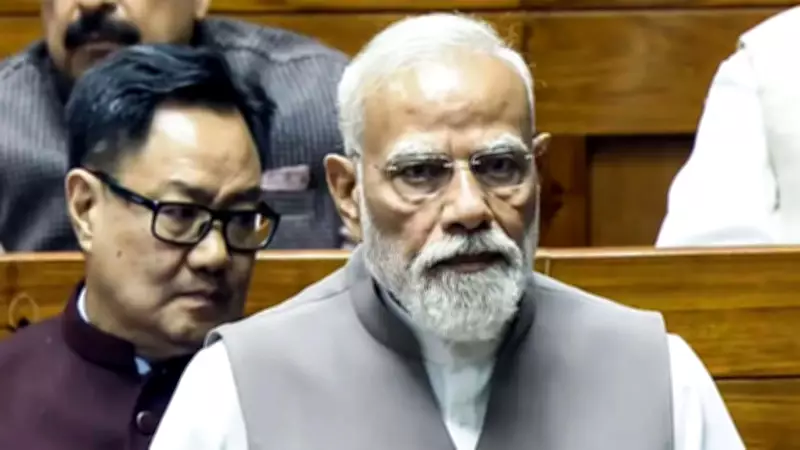
PM Modi Assures No Discrimination in Delimitation Process for Women's Quota
Prime Minister Narendra Modi on Thursday firmly rejected opposition allegations that the proposed delimitation exercise would unfairly reduce the parliamentary representation of southern states. This concern has been the central argument used by opposition parties to withhold support for three crucial constitutional amendment bills aimed at implementing a 33% reservation for women in Parliament and state legislatures.
Strong Guarantees from the Floor of Lok Sabha
Speaking during a parliamentary session marked by persistent opposition resistance, PM Modi declared from the Lok Sabha, "I say with full responsibility from this august place that this decision will not discriminate against anyone." He went further to offer multiple assurances, stating, "If you want me to say I guarantee that, then I guarantee that. If you want me to make a promise, I will make that. If you want me to use the Tamil equivalent, I'm ready for that as well."
The government has consistently maintained that the delimitation required to implement the women's quota will not diminish the Lok Sabha share of southern states. However, opposition parties remain unconvinced, creating a significant hurdle for the legislation's passage.

Historical Context and Political Stakes
PM Modi reminded the House of previous failed attempts to pass similar legislation, noting that those who blocked the women's reservation bill in 2010 "had to pay a heavy price." The current political arithmetic presents another challenge: while the NDA commands 294 seats, it requires support from opposition members to reach the two-thirds majority of 360 votes needed in the 540-member House to pass constitutional amendments.
Despite acknowledging the uncertain outcome with the phrase "number ka game to samay tay karega" (time will decide the numbers game), the Prime Minister vigorously championed the women's quota as "an important moment in the history of our nation that we should not miss."
Non-Partisan Appeal and Cultural Commitment
In his 37-minute address, PM Modi predominantly adopted a non-partisan tone, directly addressing opposition concerns about political credit. "You say and seem to fear that Modi will gain politically if bills get passed. I say you take the credit," he offered. "If you say I can write a blank cheque saying so. I will take out advertisements at government's expense, giving you credit and acknowledging your contribution."
The Prime Minister emphasized the collective nature of this endeavor, repeatedly using "we" to underscore shared responsibility. He framed the issue as "our cultural commitment as the mother of democracy," noting that "it is three decades since the idea of a quota for women in legislatures was conceived" and suggesting that "it was time we all atoned for the delay."
Warning About Consequences of Opposition
Alongside his appeals for cooperation, PM Modi issued a stark warning about the consequences of thwarting the legislation. He highlighted that the issue has transcended political circles and entered popular consciousness, particularly among women who have experienced empowerment through reservations in panchayats. "Those who oppose it will have to pay consequences for a long time to come," he cautioned, suggesting that resistance could carry significant political costs beyond immediate parliamentary calculations.
The debate continues as the government seeks to build consensus for what it describes as historic legislation, while opposition parties demand stronger guarantees about the delimitation process and its impact on federal representation.