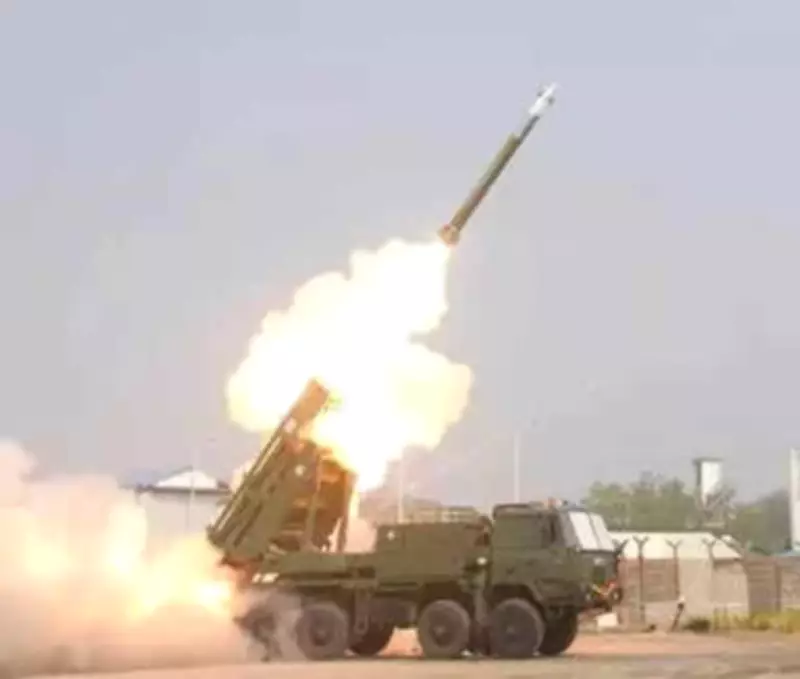
DRDO's Pinaka Rocket: India's 'Baby BrahMos' Redefines Warfare Economics
In a landmark achievement for India's defense sector, the Defence Research and Development Organisation (DRDO) successfully conducted the inaugural flight test of the Pinaka Long Range Guided Rocket in December of last year. This advanced system is now drawing comparisons to the formidable BrahMos supersonic cruise missile, which proved instrumental in pressuring Pakistan into a ceasefire during the intense four-day conflict in May 2025.
Pinaka: The Evolution into a Precision Platform
Developed through a pioneering public-private partnership between DRDO and Tata Advanced Systems Limited (TASL), the Pinaka Multi Barrel Rocket Launcher (PMBRL) is engineered to unleash a massive volume of firepower in minimal time against critical area targets. Originally known for its area-saturation capabilities, Pinaka has undergone a significant transformation, evolving from a support rocket system into a highly accurate, precision-guided platform.
Its enhanced accuracy and destructive impact, while not matching the range or speed of the BrahMos, have earned it the informal nickname "baby BrahMos." This designation is far from a mere marketing tactic; it reflects a profound shift in military strategy. As emphasized by Upendra Dwivedi, advanced yet cost-effective weapons are crucial for India to maintain operational endurance during prolonged, high-intensity conflicts. Essentially, the strategic importance of quantity has been revitalized in contemporary warfare.

Parliamentary Endorsement of Strategic Shift
The Parliament's Standing Committee on Defence has formally backed this strategic realignment. In a recent report, the committee stressed that India must possess the capability to domestically manufacture weapons in large quantities at reduced costs, particularly to sustain operations during extended conflicts. This recommendation dovetails perfectly with the government's Aatmanirbhar Bharat initiative in defense.
A growing portion of the defense budget is now allocated to indigenous procurement, diminishing dependence on foreign suppliers who might face geopolitical constraints in wartime scenarios.
How Pinaka Aligns with Modern Warfare Economics
Recent global conflicts have fundamentally altered the economics of warfare, highlighting the critical role of cost asymmetry:
- In the Israel-Hamas conflict, Israel reportedly used interceptor missiles worth lakhs to counter rockets costing only a few thousand.
- The Russia-Ukraine war has seen inexpensive drones destroy tanks and armored vehicles valued at crores.
- In conflicts in Sudan and Myanmar, non-state actors have utilized low-cost, improvised systems to disrupt conventional military forces.
This pattern underscores that modern conflicts are no longer won solely by a few technologically superior platforms. Instead, victory hinges on maintaining extensive stockpiles of affordable, domestically produced weaponry. This is precisely where the Pinaka system excels. Unlike the BrahMos cruise missile, which targets high-value assets, Pinaka rockets can be manufactured in significantly larger numbers and deployed repeatedly, offering sustained firepower.
From Domestic Program to Global Player
The Pinaka system is no longer confined to India's borders. Armenia has emerged as its first international buyer, receiving the system under an agreement signed in September 2022. Additionally, France has expressed interest in the platform. This export success is vital, as it strengthens production lines, which in turn enhances India's war readiness and solidifies its position in the global defense market.