

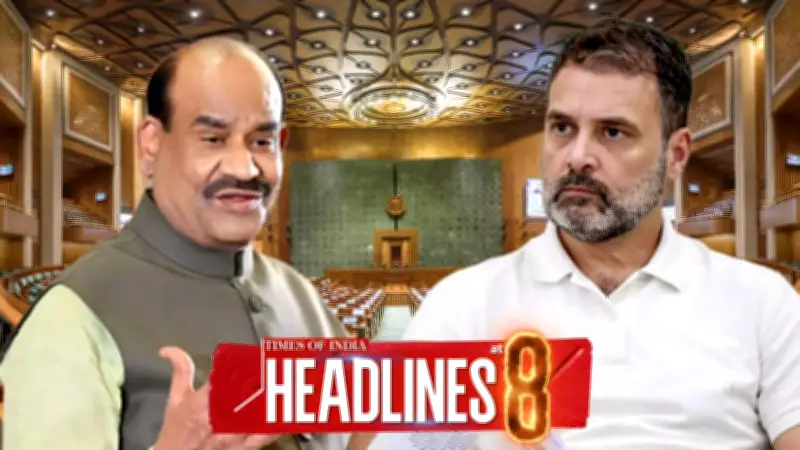
Opposition Parties Mull Unprecedented No-Confidence Motion Against Lok Sabha Speaker Om Birla
Political turmoil has gripped India's Parliament as Opposition parties are reportedly contemplating a highly unusual and significant move: a no-confidence motion against Lok Sabha Speaker Om Birla. This dramatic development comes amid escalating tensions and represents a serious challenge to parliamentary norms and procedures.
Suspension of MPs Triggers Parliamentary Crisis
The catalyst for this extraordinary political maneuver was the recent suspension of eight Opposition Members of Parliament from the Lok Sabha. The suspended MPs have been barred from participating in parliamentary proceedings, creating a significant disruption in legislative business and opposition representation.
Opposition leaders have leveled serious allegations against Speaker Om Birla, accusing him of displaying clear bias in his conduct. The charges include claims that he has been shielding Bharatiya Janata Party (BJP) MPs from parliamentary discipline while simultaneously cracking down harshly on dissent from Opposition members.

One of the most contentious accusations involves Congress leader Rahul Gandhi, with Opposition parties claiming that the Speaker's actions amount to an attempt to gag and silence one of their most prominent voices in Parliament. This allegation has further intensified the political standoff and contributed to the deteriorating atmosphere in the House.
Separate Political Flashpoint: RSS Chief's Bharat Ratna Proposal for Savarkar
Simultaneously, a separate but equally contentious political controversy has erupted outside Parliament. Rashtriya Swayamsevak Sangh (RSS) chief Mohan Bhagwat has publicly advocated for awarding the Bharat Ratna, India's highest civilian honor, to Vinayak Damodar Savarkar, the controversial historical figure and Hindu nationalist ideologue.
The Congress party has responded with forceful criticism to Bhagwat's proposal. Congress leaders have questioned whether Savarkar deserves such recognition, particularly citing his alleged role in shaping the two-nation theory that ultimately led to the partition of India and Pakistan. This historical debate has added another layer of complexity to the already charged political environment.
The convergence of these two controversies—the parliamentary crisis involving the Speaker and the ideological debate over historical figures—has created a perfect storm in Indian politics, with implications that extend far beyond the immediate parliamentary session. The situation represents a significant test of India's democratic institutions and parliamentary traditions.
Broader Implications for Parliamentary Democracy
The potential no-confidence motion against the Lok Sabha Speaker, if pursued, would be an exceptionally rare occurrence in Indian parliamentary history. Such a move underscores the depth of the rift between the ruling party and the Opposition, suggesting that conventional parliamentary mechanisms for resolving disputes have broken down.
Political analysts are closely monitoring how this situation will develop, particularly regarding:
- The procedural aspects of any potential no-confidence motion against the Speaker
- The possibility of reconciliation or mediation efforts to defuse the parliamentary crisis
- The impact on legislative productivity and important pending bills
- The broader implications for India's democratic norms and institutions
As the political drama unfolds, all eyes remain on Parliament, where the delicate balance between majority rule and minority rights faces one of its most serious challenges in recent years. The outcome of this confrontation could have lasting consequences for how parliamentary democracy functions in India.






