

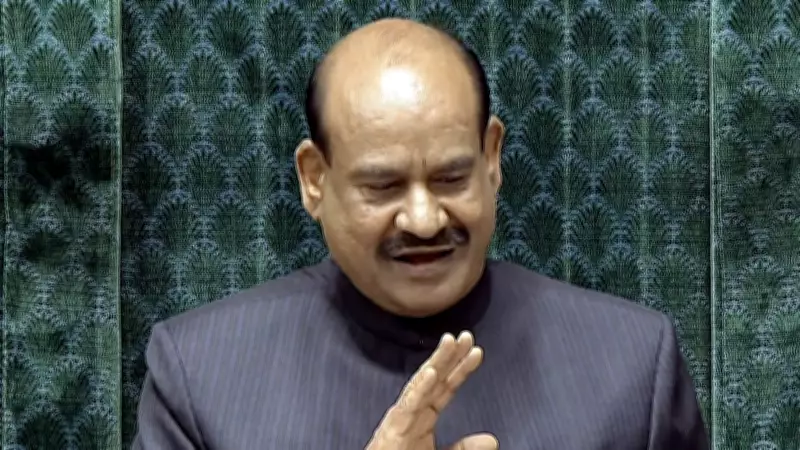
Opposition Rift Emerges Over Proposed No-Trust Motion Against Speaker Om Birla
The political impasse in the Lok Sabha intensified on Monday as Opposition parties failed to present a united front regarding a potential no-confidence motion against Speaker Om Birla. The deadlock persisted after the government declined to accommodate the Opposition's primary demand: permitting Leader of Opposition Rahul Gandhi to address the House prior to the Union Budget discussion.
Opposition Demands and Internal Discord
During a meeting of Opposition floor leaders at the commencement of the day's proceedings, a three-point ultimatum was issued to Speaker Birla. The demands included revoking the suspension of eight Opposition MPs, providing clarification on his remarks concerning Congress women MPs' alleged protest plans against Prime Minister Narendra Modi, and expunging BJP MP Nishikant Dubey's comments about Congress leaders from parliamentary records.
Following this meeting, sources indicated that the Opposition would contemplate initiating a no-confidence motion against the Speaker if these concerns remained unaddressed. A senior Congress leader confirmed that while the motion was discussed among floor leaders, a broader meeting involving all Opposition leaders would be necessary before proceeding further.

However, significant cracks within the INDIA bloc became apparent later in the day. The Samajwadi Party (SP) and the Trinamool Congress (TMC), two of the largest constituents after the Congress, expressed divergent positions. SP sources stated their party would support the motion but awaited the Congress to take the lead. In contrast, a TMC MP revealed that their party had made no firm commitment and would await instructions from their leadership in Kolkata.
A TMC leader pointedly questioned the Congress's resolve, asking, "The Congress itself isn't sure. If they are bringing a motion against Birla, then why did K C Venugopal go and meet the Speaker?" This referred to a meeting between Congress General Secretary for Organisation K C Venugopal and Speaker Birla aimed at resolving the standoff.
Constitutional and Procedural Hurdles
According to former Joint Secretary (Legislation) of the Lok Sabha Secretariat, Ravindra Garimela, moving a no-confidence motion against the Speaker involves stringent constitutional requirements. Under Article 94C of the Constitution, a minimum 14-day notice is mandatory, needing just two signatures for submission.
Garimela elaborated, "The Speaker's removal is possible only by a resolution passed by the majority of the actual strength of the Lok Sabha, including absentees. Currently, this threshold requires 271 affirmative votes. The framers' intent is clear: while the Speaker must remain accountable to the House, the office must be insulated from transient political majorities or partisan retaliation."
He further detailed the procedural architecture: "Leave of the House must be sought, with at least 50 Members rising in support before the motion can proceed. The resolution, once admitted, receives priority in House business, yet debate is carefully regulated."
Congress Accusations and Government Stance
Earlier in the day, Venugopal launched a sharp critique against the Speaker, alleging parliamentary bias. "Whatever is happening in Parliament is very unfortunate. The LoP acts as a shadow PM. But in this Parliament, when the LoP stands up to say something, the mic gets switched off. In fact, nobody from the Opposition gets time to speak. This Parliament has become a place where the Opposition has no voice," Venugopal asserted.
Meanwhile, Rahul Gandhi continued his attacks on Prime Minister Modi, telling reporters at the Parliament complex that the PM was "scared of the issue of former Army chief M M Naravane's book." He challenged that if the PM genuinely believed some Congress women MPs threatened him, an FIR should be registered.

Gandhi further accused the government of fearing Budget discussions to avoid questions on the US trade deal and its impact on farmers. Congress whip Manickam Tagore echoed this, stating, "It is clear that the government does not want the discussion on the budget because the trade deal will be a key topic. The trade deal is a 'trap-deal' in which they have sold the farmers' interests. When Rahul Gandhi ji speaks, he will raise this issue, so they do not want the debate at all."
Parliamentary Proceedings and Adjournment
After two adjournments, the Lok Sabha reconvened at 2 pm with BJP MP Sandhya Ray presiding. She invited Congress MP Shashi Tharoor to initiate the Budget debate. Tharoor insisted that Gandhi, as LoP, should be allowed to raise specific points first. Ray responded that she had no objection if Gandhi wished to speak on the Budget directly.
Gandhi countered, claiming an agreement had been reached during a meeting between Birla and Opposition MPs that he would be permitted to raise certain issues pre-debate, and accused the Chair of reneging. Ray denied knowledge of any such pact, stating she could not allow extraneous issues without prior notice.
Parliamentary Affairs Minister Kiren Rijiju intervened, denying any agreement existed and insisting that if the LoP wished to comment on the Speaker, Birla should be present to respond. With neither side yielding, Ray adjourned the proceedings for the day, prolonging the parliamentary stalemate.





